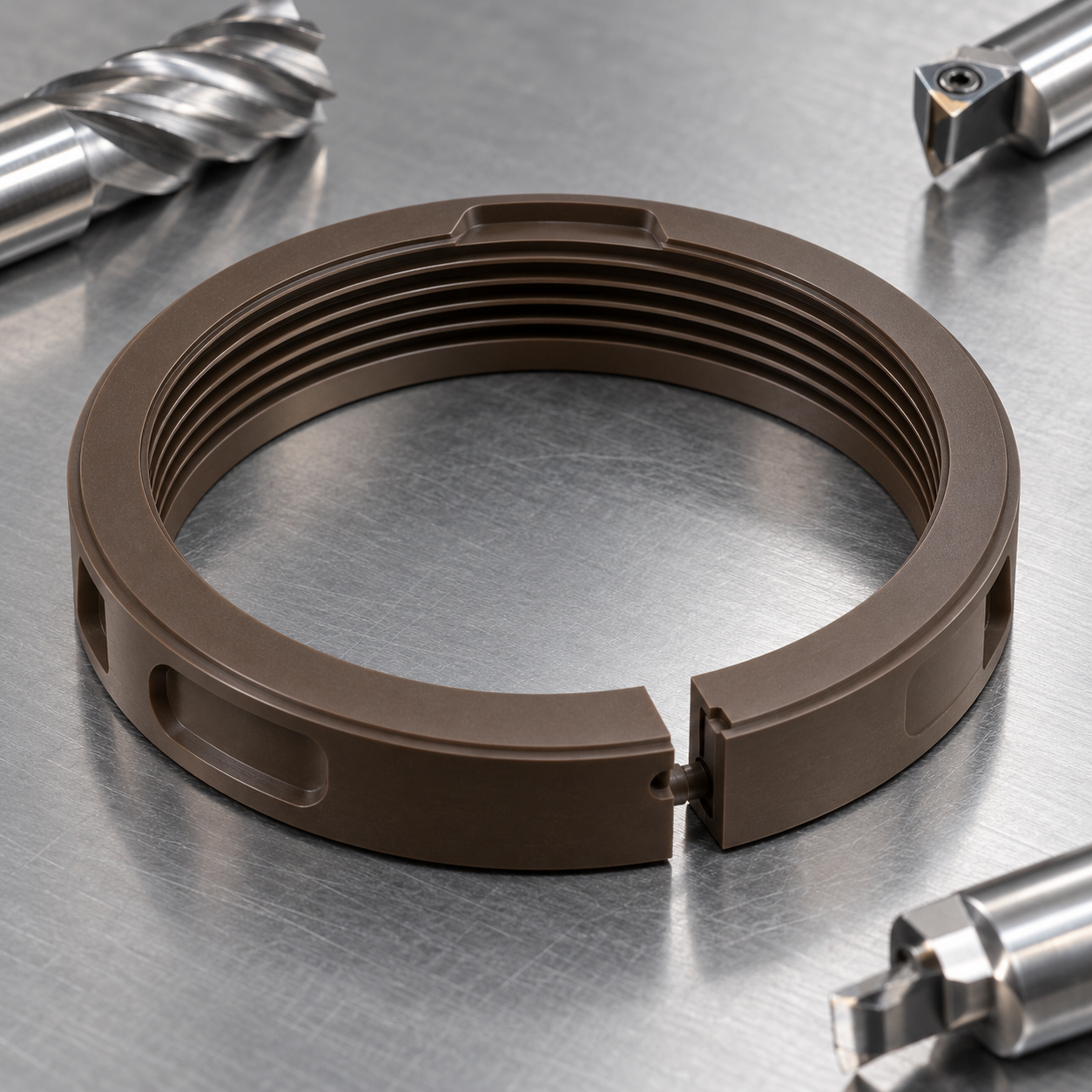
English: Torlon 4301 Labyrinth Seal Tooling for Thin Teeth, Split Joint and Balance Pockets
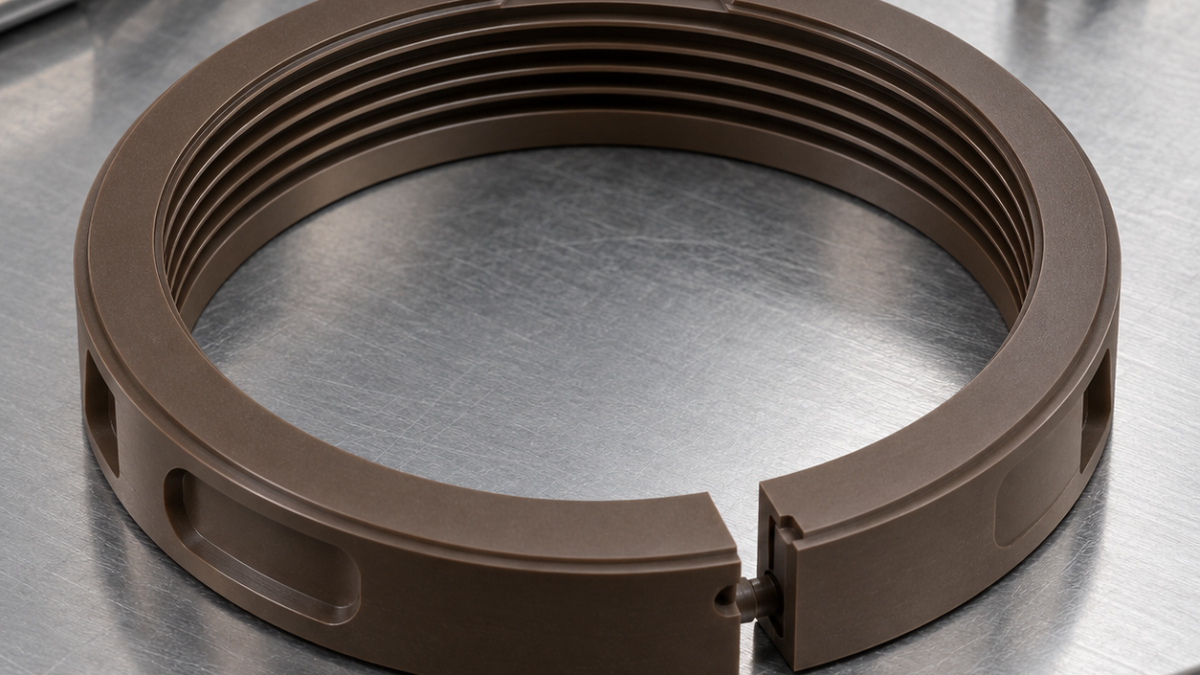
The critical question is how much radial force each operation spends from the ring’s distortion budget. The thin teeth are not independent grooves: tooth pitch, free-state roundness and split-joint gap interact. The process therefore measures the ring after every stiffness-changing feature rather than trusting clamped dimensions.
Budget cutting force before tooth thickness
Rough the blank as a closed ring on a broad diaphragm chuck. Use a polished uncoated CCGT insert for faces and bore, leaving symmetrical radial stock. Semi-finish the outside pilot, condition the part at inspection temperature, then record free roundness before cutting any labyrinth tooth.
Feature-to-tool plan for the split seal ring
| Drawing feature | Carbide tool and holder | Selection logic / rejected alternative |
|---|---|---|
| Faces, bore and pilot | Polished uncoated CCGT, high-positive geometry, precision boring bar | Sharp shear limits heat; coated metal inserts rub. |
| Thin labyrinth spaces | 1.0 mm polished carbide groover, single edge, minimal hone | Controls root and crest; a form gang tool applies excessive radial load. |
| Split joint | 2 mm single-flute polished end mill, short precision collet | Clears chips and preserves gap; a saw leaves exit fuzz. |
| Balance pockets | 4 mm 2-flute polished radius end mill, balanced holder | Symmetric low-force removal; four flutes trap warm chips. |
| Anti-rotation notch and edge breaks | 3 mm 2-flute end mill plus single-flute 90° chamfer tool | Separate tools keep the notch datum sharp and the break measurable. |
Machine a closed ring before creating the split
Turn the teeth with a 1.0 mm polished carbide grooving insert ground with high positive rake and almost no hone. Cut alternating tooth spaces in two passes so heat and radial force do not accumulate on one side. A coated steel groover is rejected because its edge radius rubs Torlon and rounds the tooth crest.
Finish teeth with heat-free chip evacuation
Mill the split joint with a 2 mm single-flute polished end mill while a sacrificial bridge still supports the ring; remove the bridge last with the ring seated on a full-radius nest. Machine balance pockets symmetrically using a 4 mm two-flute cutter. Inspect free gap, roundness, tooth pitch, crest thickness and burr height after thermal stabilization.
Related tooling comparisons: polymer thin-land inspection; high-temperature polymer ring tooling.
Torlon labyrinth-ring FAQ
Can the teeth be cut after splitting? Only with a calibrated closure fixture; otherwise gap force changes pitch. Why no heavy coolant? Dimensional temperature and fluid compatibility matter; clean air plus extraction is clearer. Tool-life trigger? Glossy roots, rising burr and crest-radius growth.