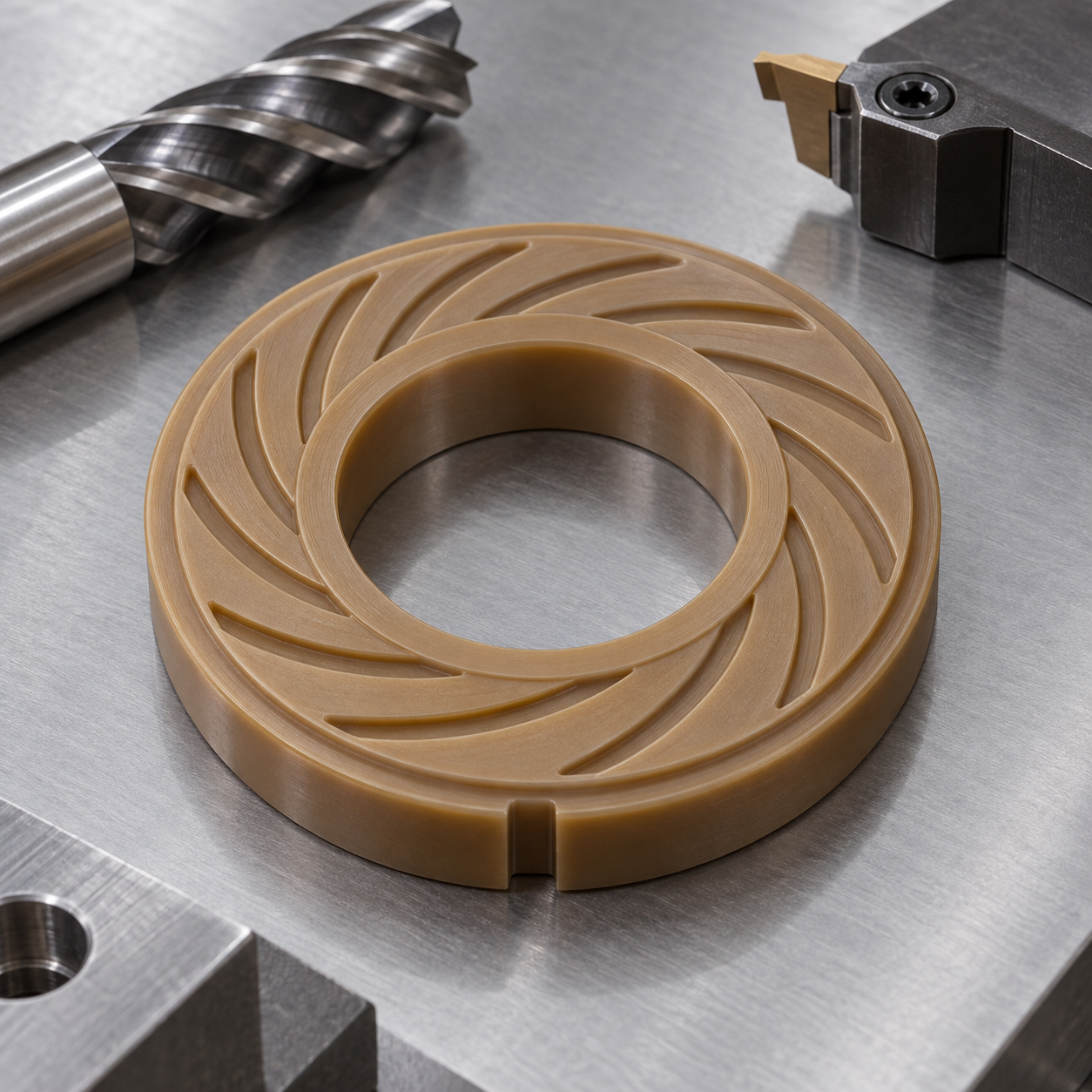
English: PEEK HPV Thrust Washer Tooling for Spiral Oil Grooves and a Thin Land
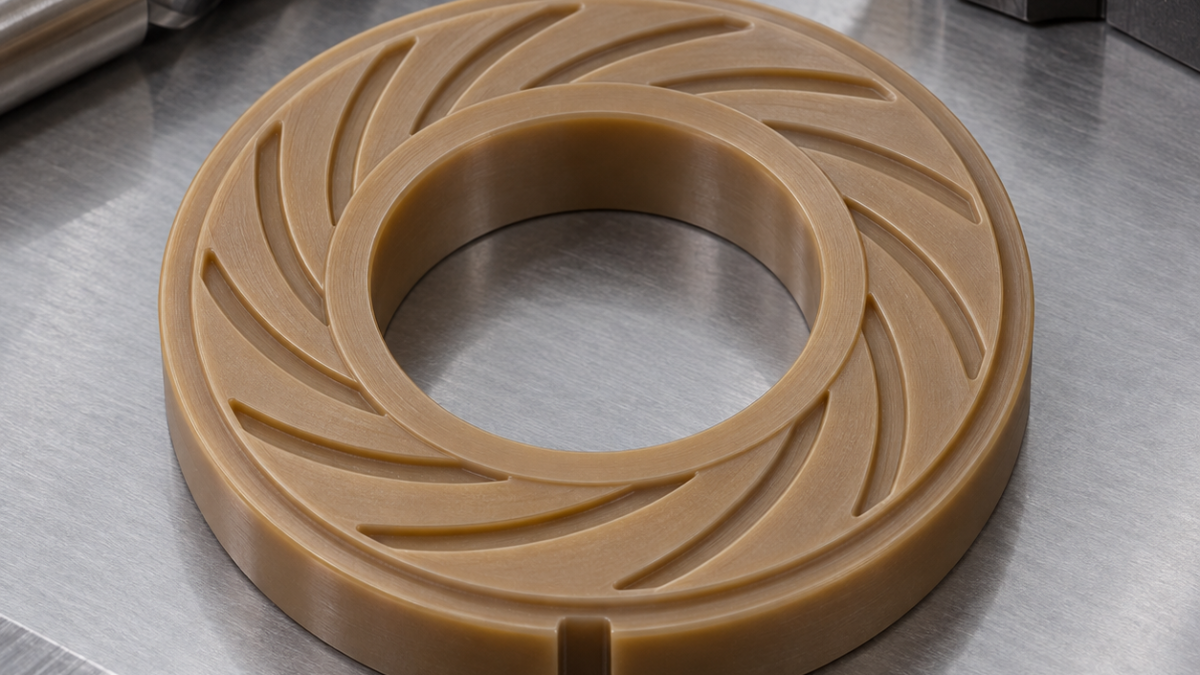
The drawing’s decisive requirement is the volume and exit condition of each spiral oil groove, not merely the washer diameter. The running land is thin enough to dish under chuck pressure, while HPV-grade filler makes the polymer more abrasive than unfilled PEEK. Tool choice must balance a keen shearing edge with predictable wear before the groove width narrows.
Treat groove volume and free-state flatness as one system
Saw the blank oversize and condition it before machining. Face one side on a sacrificial vacuum plate with a broad porous support, turn the bore and outside diameter with a polished uncoated carbide insert, then flip onto a ground expanding arbor that contacts the robust hub rather than the thin running land. Leave opposing face stock until the groove pattern is complete.
Tool map for the washer’s functional surfaces
| Drawing feature | Carbide tool and holder | Selection logic / rejected alternative |
|---|---|---|
| Datum face, bore and OD | Polished uncoated CCGT insert, minimal hone, precision boring bar | Shears rather than ploughs; a coated steel grade can rub and heat the polymer. |
| Spiral lubrication grooves | 2 mm single-flute polished carbide end mill, balanced precision collet | Large flute clears chips; four flutes recut warm debris and narrow the passage. |
| Thin running land | 6 mm 2-flute high-positive face finisher, very light axial stock | Low force protects flatness; a broad fly cutter can lift the unsupported ring. |
| Anti-rotation notch | 3 mm short 2-flute polished carbide end mill | Short reach holds notch position; a long slot drill deflects at entry. |
| Edge breaks | 90° single-flute carbide chamfer tool with axial stop | Makes a controlled break; hand deburring rounds the oil-metering exits. |
Support the ring without printing the jaws
Mill each spiral with a 2 mm single-flute polished carbide cutter using constant engagement and an outward path that lets the chip leave the edge. A two- or four-flute metal end mill packs warm dust in the channel. Finish the anti-rotation notch with a short 2-flute high-positive cutter and apply only the specified edge break using a single-flute chamfer tool; hand scraping changes the notch datum.
Cut the spiral without melting its exit
Measure groove width and depth at several radii, then calculate or scan groove volume because two grooves can share maximum depth but move different oil quantities. Check flatness after the part rests free at inspection temperature. Monitor spindle load, white dust, glossy groove walls and exit burr height as a combined tool-life signature; the first glossy streak is more useful than waiting for size failure.
Related tooling comparisons: thin polymer groove strategy; abrasive PEEK composite tooling.
Questions machinists ask about PEEK HPV washers
Should coolant be flooded? Only if the specified fluid is compatible and chips can be removed; clean air and extraction are often clearer. Why an expanding arbor? It locates the bore while avoiding jaw print on the land. Can the groove be polished? Not as a substitute for a sharp cutter because polishing alters volume and edge geometry.