Related tooling references: PPSU Sterilization Tray Latch Rail CNC Tool Selection for Snap Hooks and Drain Slots and H13 Hot Runner Nozzle Tip CNC Tool Selection for Conical Gate Seat and Spiral Heater Groove.
English: Tungsten Collimator Tooling for Stepped Slit and Dovetail Rail
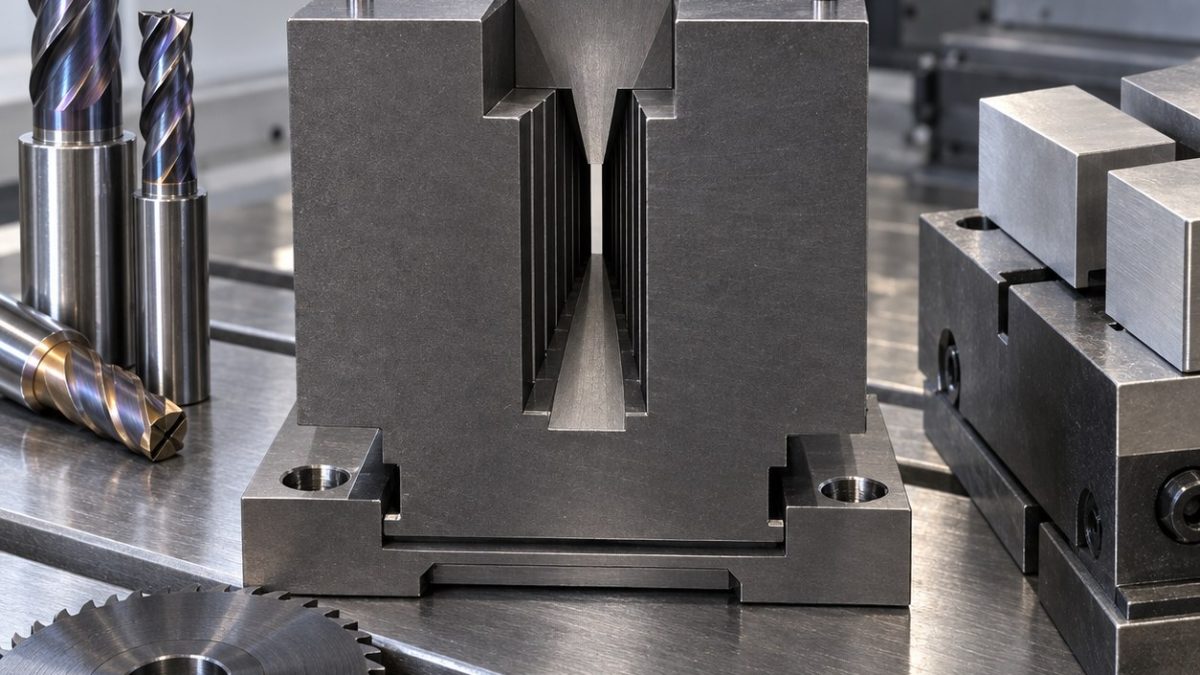
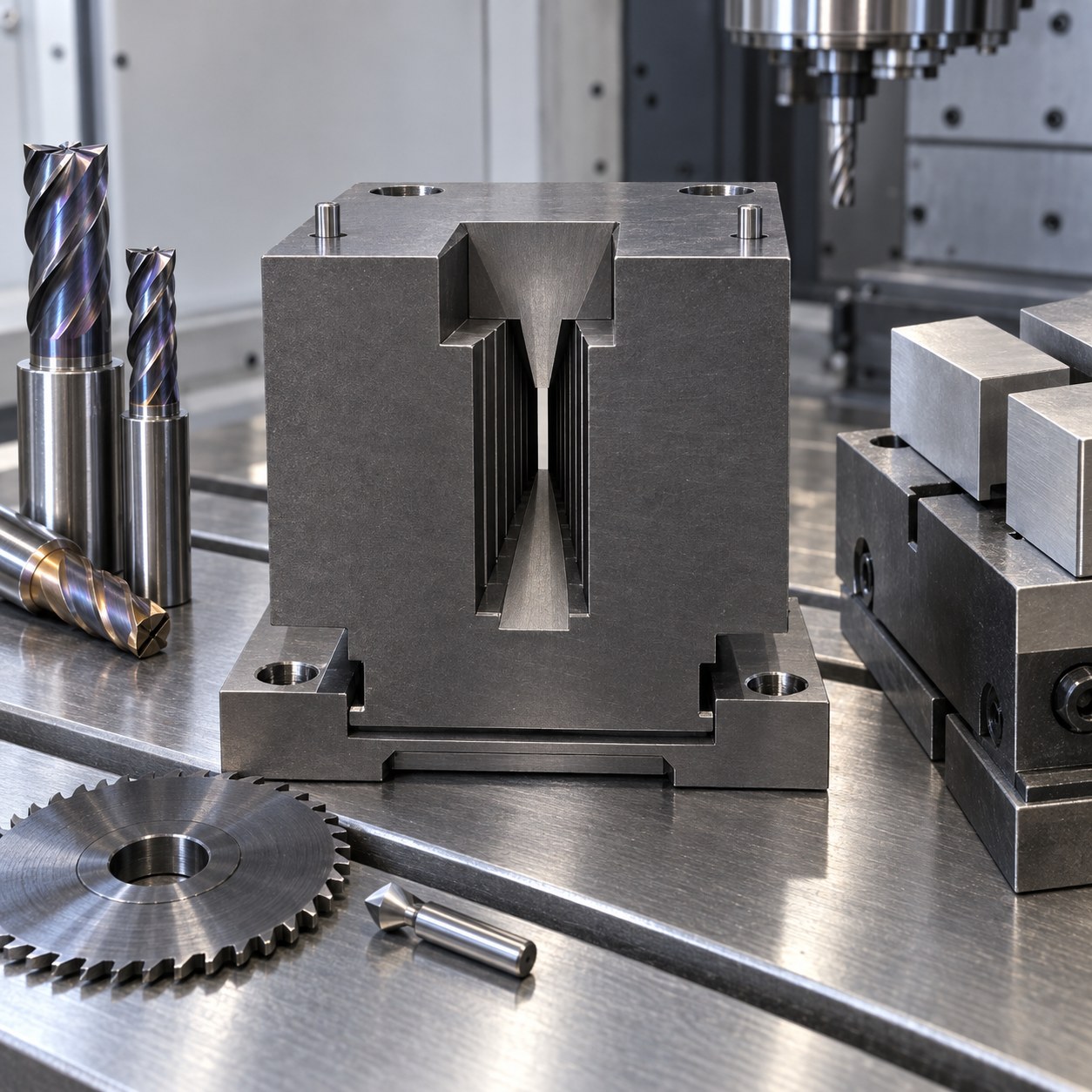
This tungsten collimator case focuses on a stepped slit aperture and dovetail rail where the drawing feature that looks small controls function. Tooling is chosen to hold straight aperture walls while protecting thin septum ribs.
Collimator drawing features and cutter choice
| Feature | Tool and holder | Rejected alternative |
|---|---|---|
| Stepped slit aperture | 1.5 mm coated carbide necked end mill followed by micro slotting saw | The slit wall needs straightness; wire EDM is rejected for edge recast cleanup. |
| Thin septum ribs | 0.8 mm carbide finishing end mill, low radial engagement | Protects rib load; heavy roughing would snap the septa. |
| Dovetail rail | Form dovetail carbide cutter in rigid shrink holder | One controlled form pass keeps seating angle consistent. |
| Countersunk holes | Carbide drill, piloted counterbore and small chamfer mill | Separates screw seating from abrasive hole drilling. |
| Datum base | 50 mm positive carbide face mill, light passes | Controls flatness without hammering dense tungsten. |
Aperture-first machining sequence
Face the datum, rough the block conservatively, open the slit in balanced passes, finish the septa, and cut the dovetail only after the insert seats repeatably. Counterbores are last to keep clamping away from fragile internal ribs.
Tungsten edge and dust control
Tungsten heavy alloy is dense and abrasive. The process uses rigid holders, coated carbide, dust extraction, small radial engagement and frequent edge inspection. A tool is retired when it begins polishing rather than shearing.
Aperture inspection plan
Optical slit width, pin access, rail seating angle, base flatness and burrs on the radiation path are checked before acceptance.
Tungsten tooling FAQ
Why not rely on wire EDM for the slit?
The hypothetical plan avoids recast cleanup on radiation-path edges.
Which feature is most fragile?
The thin septum ribs beside the stepped aperture.
How is dust handled?
With dry extraction and short tool inspections rather than flood coolant slurry.
中文: 钨合金准直器嵌件阶梯狭缝与燕尾导轨配刀
这个钨合金准直器案例聚焦阶梯狭缝和燕尾导轨:图纸上看似很小的狭缝决定功能。刀具选择必须保持孔径壁直线度,同时保护薄隔片筋。
准直器图纸特征与刀具选择
| 特征 | 刀具与刀柄 | 放弃方案 |
|---|---|---|
| 阶梯狭缝 | 1.5 mm缩颈涂层硬质合金刀后接微型锯片 | 狭缝壁要直;线割因重铸层清理被放弃。 |
| 薄隔片筋 | 0.8 mm硬质合金精刀,小径向切深 | 保护薄筋受力;重粗铣会折断隔片。 |
| 燕尾导轨 | 成形燕尾硬质合金刀,热缩刀柄 | 一次受控成形保证座角一致。 |
| 沉头孔 | 硬质合金钻、导向沉孔刀、小倒角刀 | 把螺钉座面与磨蚀性钻孔分开。 |
| 基准底面 | 50 mm正前角硬质合金面铣刀,轻切 | 控制平面度且不敲击高密度钨合金。 |
先狭缝后导轨的顺序
先精加工基准面,保守粗加工毛坯,平衡刀路打开狭缝,再精修隔片筋;嵌件能重复就位后再切燕尾。沉孔放在最后,避免夹紧力作用到内部薄筋。
钨合金边缘和粉尘控制
钨重合金密度高且磨蚀。流程使用刚性刀柄、涂层硬质合金、粉尘抽吸、小径向切深和频繁刃口检查。刀具开始抛光而不是切削时立即停用。
狭缝检测方案
验收前检查狭缝光学宽度、针规可达性、导轨座角、底面平面度以及辐射通道上的毛刺。
钨合金配刀问答
为什么不直接用线割做狭缝?
本方案避免辐射通道边缘的重铸层清理风险。
最脆弱的特征是什么?
阶梯狭缝旁的薄隔片筋。
粉尘如何处理?
用干式抽吸和短周期刃口检查,而不是形成冷却液泥浆。
Español: Herramientas para colimador de tungsteno con ranura
El colimador de tungsteno depende de una abertura estrecha y septos finos. La herramienta debe mantener pared recta.
Rasgos de colimador y corte
| Elemento | Herramienta | Alternativa |
|---|---|---|
| Abertura escalonada | Fresa 1,5 mm y sierra micro | Pared recta. |
| Septos | Fresa 0,8 mm ligera | No rompe nervios. |
| Cola milano | Fresa de forma rígida | Ángulo estable. |
| Avellanados | Broca y avellanador piloto | Separa asiento. |
| Base datum | Fresa frontal 50 mm | Planitud suave. |
Secuencia de abertura
Datum, desbaste suave, apertura equilibrada, acabado de septos y cola de milano al final.
Borde y polvo de tungsteno
El tungsteno es denso y abrasivo; porta rígido, carburo recubierto, extracción y poco engagement.
Control de abertura
Se inspecciona ancho óptico, ángulo de riel, planitud y rebaba.
FAQ tungsteno
¿Por qué no EDM?
Evita recast.
¿Elemento frágil?
Septos finos.
¿Polvo?
Extracción seca.
Français: Outils pour collimateur tungstène à fente
Le collimateur tungstène dépend d’une fente étroite et de cloisons fines. L’outil doit garder des parois droites.
Collimateur et choix outil
| Élément | Outil | Option rejetée |
|---|---|---|
| Fente étagée | Fraise 1,5 mm et micro-scie | Paroi droite. |
| Cloisons | Fraise 0,8 mm légère | Préserve les cloisons. |
| Queue aronde | Fraise de forme rigide | Angle constant. |
| Trous fraisés | Foret et fraisoir guidé | Assise séparée. |
| Base datum | Fraise 50 mm | Planéité douce. |
Séquence de fente
Base, ébauche douce, ouverture équilibrée, finition cloisons puis queue d’aronde.
Arête et poussière tungstène
Tungstène dense et abrasif: porte-outil rigide, carbure revêtu, aspiration et faible engagement.
Contrôle ouverture
Largeur optique, angle du rail, planéité et bavures sont contrôlés.
FAQ tungstène
Pourquoi pas EDM?
Pour éviter la recouche.
Élément fragile?
Cloisons fines.
Poussière?
Aspiration sèche.
Русский: Инструмент для коллиматора
Коллиматор из вольфрама зависит от узкой щели и тонких перегородок. Нужны прямые стенки.
Коллиматор и выбор фрез
| Элемент | Инструмент | Отклонено |
|---|---|---|
| Ступенчатая щель | Фреза 1,5 мм и микропила | Прямая стенка. |
| Перегородки | Фреза 0,8 мм легкий рез | Не ломает ребра. |
| Ласточкин хвост | Форм-фреза жесткая | Угол стабилен. |
| Зенковки | Сверло и направленная зенковка | Отдельная посадка. |
| База | Фреза 50 мм | Мягкая плоскость. |
Порядок щели
База, мягкая черновая, сбалансированная щель, чистка перегородок и потом хвост.
Кромка и пыль вольфрама
Вольфрам плотный и абразивный: жесткая оправка, покрытый карбид, вытяжка и малое зацепление.
Контроль щели
Проверяют ширину, угол рейки, плоскость и заусенцы.
Вопросы вольфрам
Почему не EDM?
Нет очистки переплава.
Что хрупкое?
Тонкие перегородки.
Пыль?
Сухая вытяжка.