Related tooling references: GG25 Cast Iron Vacuum Pump End Cover CNC Tool Selection for Spiral Seal Groove and Dowel Bore Grid and Delrin AF Rotary Indexing Star Wheel CNC Tool Selection for Ratchet Teeth and Spring Detent Pockets.
English: H13 Hot Runner Nozzle Tooling for Gate Seat and Heater Groove
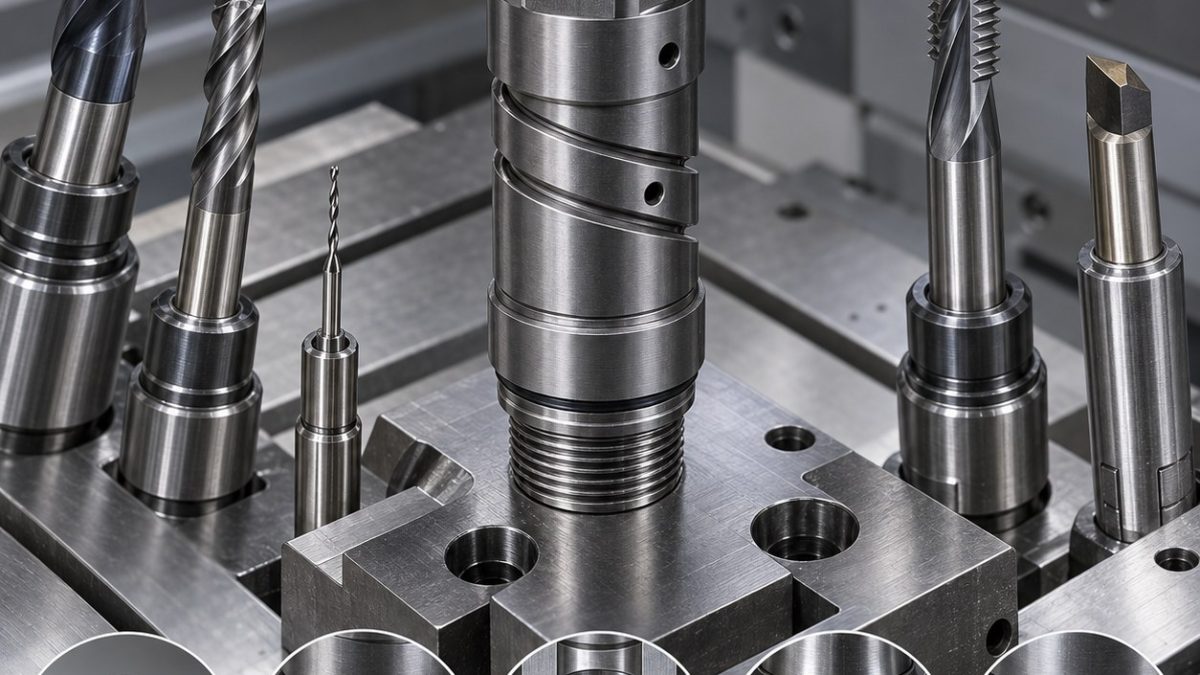
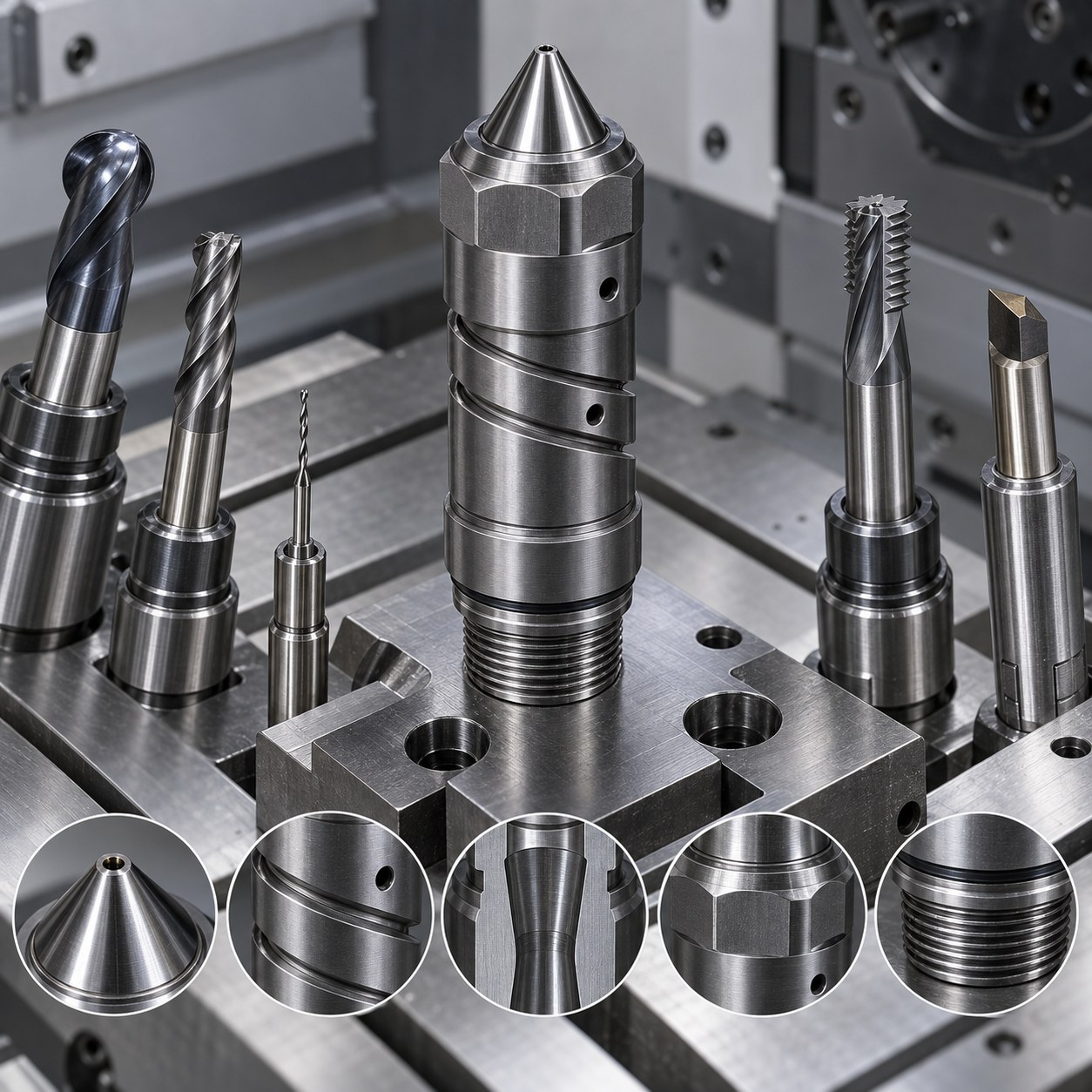
This H13 hot runner nozzle case focuses on tool selection for a hard or semi-hard mold component where the drawing links a sealing gate cone, heater groove and micro thermocouple hole. The first answer is simple: protect the conical gate seat and select every other tool around that datum.
H13 nozzle features mapped to cutters
| Nozzle feature | Tool and holder selection | Rejected alternative |
|---|---|---|
| Conical gate seat | CBN or AlTiN carbide form finisher, 0.2 mm nose preparation, shrink holder | A ball tool is rejected because cusp direction can cross the sealing cone. |
| Spiral heater groove | 2 mm necked carbide ball end mill, hard-milling grade, air blast | Small radius follows the helix without burning; EDM is avoided because it delays groove edge cleanup. |
| Thermocouple hole | 0.8 mm carbide micro drill with guided spot and peck cycle | Position is more important than speed; a long unsupported drill would walk on H13 skin. |
| Hex wrench flats | 8 mm 5-flute variable pitch carbide end mill | After bore finishing, light flat milling avoids moving the conical seat. |
| Tapered melt bore | Carbide pilot drill, micro boring bar and polished reamer allowance | The bore must be coaxial with the gate seat; direct drilling is not accurate enough. |
Heat-treated nozzle process plan
Establish the melt bore axis, semi-finish the cone, cut the spiral heater groove with balanced shallow passes, then drill the thermocouple hole from a guided spot. Hex flats are machined late with light radial engagement so the body is not squeezed around the bore.
Hard-milling and micro-hole risk controls
H13 hard milling fails when the edge rubs and polishes instead of cutting. The plan uses prepared carbide or CBN for the cone, necked tools for groove reach, air blast instead of chip recutting and conservative micro-drill pecks. A worn ball tool is rejected before it rounds the heater groove corner.
Gate seat and heater groove inspection
The nozzle is checked by optical cone angle, bore runout, groove width, thermocouple hole pin entry and visual edge condition. The gate seat receives separate magnified inspection because any burr there is a molding defect, not a cosmetic mark.
H13 nozzle tooling FAQ
Why is the cone inspected separately?
A tiny burr on the gate cone can print into molded parts or cause leakage.
When should CBN be used?
When the H13 condition is hard enough that carbide polishing becomes faster than cutting.
Can the heater groove be EDM cut?
It can, but this case rejects it because groove-edge cleanup and recast control add another risk.
中文: H13热流道喷嘴浇口锥座与螺旋加热槽配刀
这个H13热流道喷嘴案例关注硬态或半硬态模具零件的配刀:图纸把浇口密封锥面、加热槽和热电偶微孔联系在一起。首要原则很明确:保护浇口锥座,其他刀具都围绕这个基准选择。
H13喷嘴特征到刀具映射
| 喷嘴特征 | 刀具与刀柄选择 | 放弃的替代方案 |
|---|---|---|
| 浇口锥座 | CBN或AlTiN硬质合金成形精刀,0.2 mm刃口准备,热缩刀柄 | 球刀会留下横穿密封锥面的残留纹,因此不用。 |
| 螺旋加热槽 | 2 mm缩颈硬质合金球刀,硬铣牌号,气冷 | 小半径能跟随螺旋且不烧伤;EDM会增加槽边清理。 |
| 热电偶小孔 | 0.8 mm硬质合金微钻,导向点孔和啄钻循环 | 位置比速度重要;长悬伸钻会在H13表层跑偏。 |
| 六方扳手面 | 8 mm五刃变齿距硬质合金立铣刀 | 孔和锥面完成后轻切平面,避免移动浇口座。 |
| 锥形熔体孔 | 硬质合金导孔钻、微镗刀和抛光铰削余量 | 熔体孔必须与浇口座同轴,直接钻削不够可靠。 |
热处理后喷嘴工艺路线
先建立熔体孔轴线,半精修锥面,再用浅切平衡刀路加工螺旋加热槽,随后从导向点孔钻热电偶孔。六方面在后段轻径向切削,避免把本体压变形影响内孔。
硬铣和小孔风险控制
H13硬铣失败通常来自刃口摩擦抛光而不是切削。方案用刃口准备的硬质合金或CBN修锥面,缩颈刀保证槽深可达,气冷避免二次切削,微钻采用保守啄钻。球刀一旦磨钝,在圆角被磨圆前换刀。
浇口座与加热槽检测
检测包括锥角光学检查、内孔跳动、加热槽宽度、热电偶孔针规进入和边缘状态。浇口座单独放大检查,因为那里的毛刺会成为注塑缺陷,不是外观痕迹。
H13喷嘴配刀问答
锥座为什么单独检测?
浇口锥面上的微小毛刺会印到塑件或造成泄漏。
什么时候用CBN?
当H13硬度高到硬质合金开始抛光而不是切削时。
加热槽能EDM吗?
可以,但本案例因槽边清理和重铸层控制增加风险而放弃。
Español: Herramientas para boquilla H13 con asiento cónico
La boquilla H13 exige proteger el asiento cónico. La ranura calentadora y el microagujero se seleccionan alrededor de ese datum.
Rasgos de boquilla H13 a cortadores
| Elemento | Herramienta | Alternativa rechazada |
|---|---|---|
| Asiento cónico | Acabador de forma CBN o carburo AlTiN | Evita crestas de bola. |
| Ranura calentador | Bola carburo 2 mm con cuello | Sigue hélice sin quemar. |
| Termopar | Microbroca 0,8 mm con peck | Evita caminar. |
| Hexágono | Fresa 8 mm, 5 labios | Corte ligero. |
| Canal fundido | Piloto, micro mandrinado y escariado | Alinea con asiento. |
Proceso tras temple
Se fija el eje del canal, se semiacaba el cono, se mecaniza la hélice en pasadas suaves y luego el termopar desde punto guiado.
Riesgos de duro y microagujero
En H13 el roce destruye la arista. CBN o carburo preparado, herramientas con cuello y aire evitan recorte y quemado.
Inspección de asiento y ranura
Se verifica ángulo, salto del canal, ancho de ranura, entrada de pin del termopar y rebaba del asiento.
FAQ H13
¿Por qué inspección del cono?
Una rebaba marca la pieza moldeada.
¿Cuándo CBN?
Cuando el carburo frota más que corta.
¿EDM para ranura?
Se rechaza por recast y limpieza.
Français: Outils pour buse H13 à siège et gorge
La buse H13 impose de protéger le siège conique. Gorge chauffante et micro-trou sont choisis autour de ce datum.
Détails de buse H13 vers outils
| Élément | Outil | Option rejetée |
|---|---|---|
| Siège conique | Finition forme CBN ou carbure AlTiN | Évite les crêtes de boule. |
| Gorge chauffante | Boule carbure 2 mm à col | Suit l’hélice sans brûler. |
| Thermocouple | Micro-foret 0,8 mm | Limite la dérive. |
| Six pans | Fraise 8 mm 5 dents | Coupe légère. |
| Alésage matière | Pilote, micro-alésage et marge alésoir | Aligne le siège. |
Gamme après trempe
Axe du canal, semi-finition du cône, hélice en passes douces puis thermocouple depuis un point guidé.
Risques dur et micro-trou
En H13, le frottement détruit l’arête. CBN ou carbure préparé, outils à col et air limitent brûlure et recoupe.
Contrôle siège et gorge
Contrôle angle, battement, largeur de gorge, pige thermocouple et bavure du siège.
FAQ H13
Pourquoi contrôler le cône ?
Une bavure marque la pièce moulée.
Quand CBN ?
Quand le carbure frotte.
EDM gorge ?
Rejeté pour recouche et nettoyage.
Русский: Инструмент для сопла H13
Сопло H13 требует защиты конического седла. Канавка нагревателя и микроотверстие подчинены этой базе.
Элементы сопла H13 и инструмент
| Элемент | Инструмент | Отклонено |
|---|---|---|
| Коническое седло | Форм-финишер CBN или карбид AlTiN | Без следов шаровой. |
| Спиральная канавка | Шаровая 2 мм с шейкой | Следует спирали без перегрева. |
| Термопара | Микросверло 0,8 мм | Не уводит отверстие. |
| Шестигранник | Фреза 8 мм 5 зубьев | Легкий рез. |
| Конический канал | Пилот, микроточение и припуск развертки | Соосность с седлом. |
Процесс после закалки
Задают ось канала, получистят конус, режут спираль мягкими проходами и сверлят термопару от направляющей точки.
Риски твердой фрезеровки и микроотверстия
В H13 трение быстро убивает кромку. CBN или подготовленный карбид, шейковые фрезы и воздух снижают перегрев.
Контроль седла и канавки
Контроль угла, биения, ширины канавки, входа штифта и заусенца седла.
Вопросы H13
Почему конус отдельно?
Малый заусенец даст дефект отливки.
Когда CBN?
Когда карбид больше трется.
Можно EDM?
Отклонено из-за переплава и очистки.