Related tooling references: Monel K-500 Marine Clevis CNC Tool Selection for Fork Slot, Pin Bore and Fillet Relief and Zerodur Mirror Cell CNC Tool Selection for Lightweight Pockets and Bond Pad Flats.
English: Polycarbonate Light Pipe Tooling for Polished V-Grooves and Snap Tabs
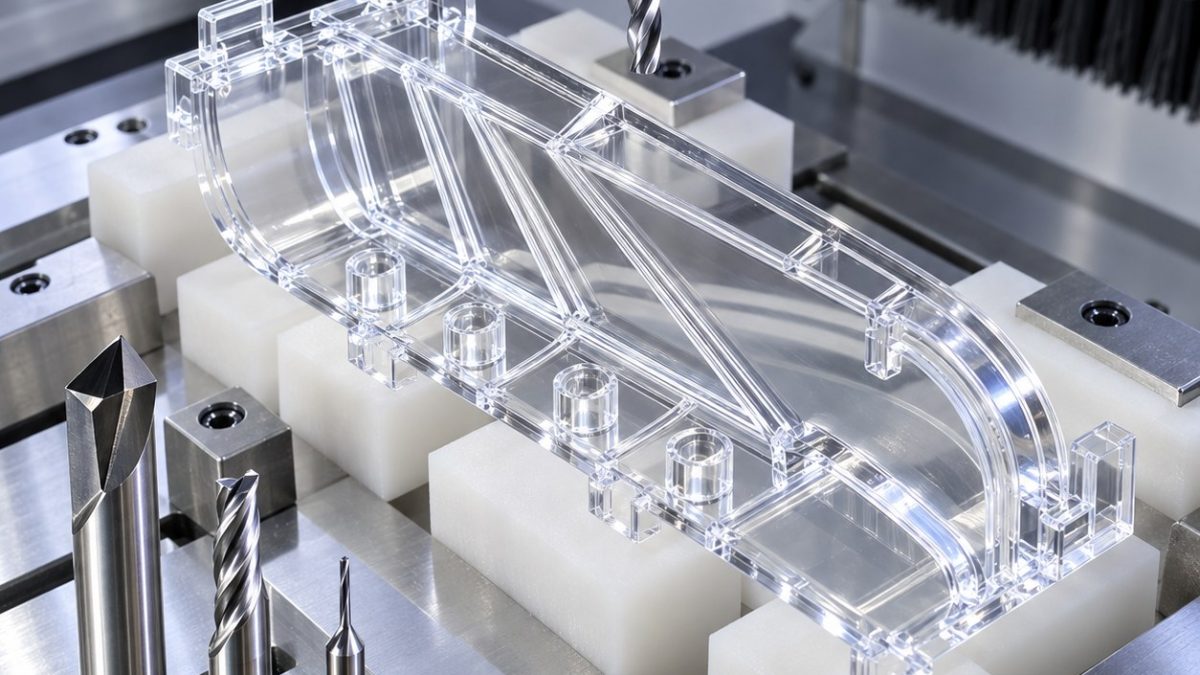
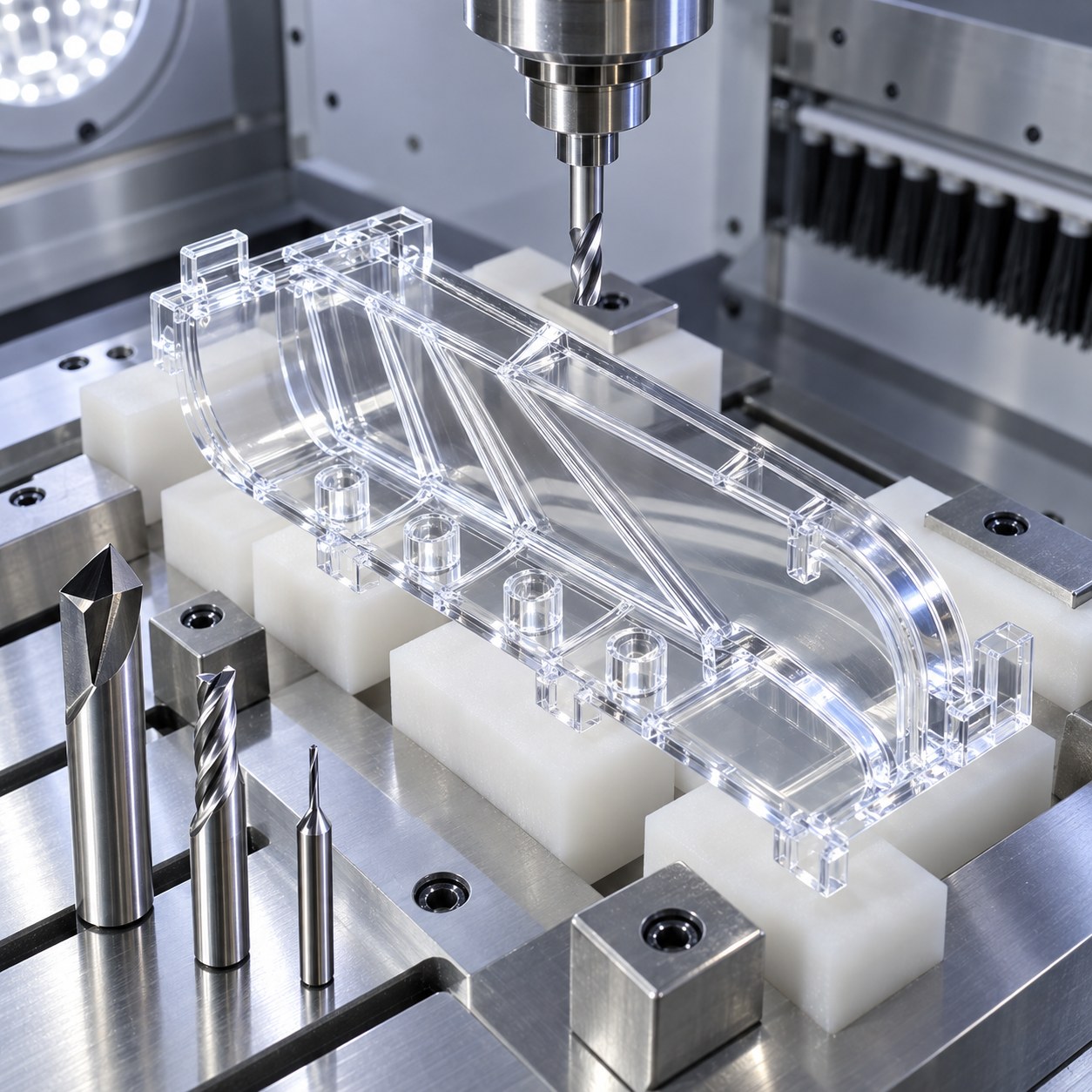
The intent here is practical polycarbonate light pipe tooling: how to cut polished V-grooves and snap tabs without turning clear edges white. The drawing is optical first and mechanical second, so cutter rake, support and heat control matter more than aggressive feed claims.
Optical plastic features and cutter geometry
| Light-pipe feature | Tool selection | Reason on the drawing |
|---|---|---|
| Polished V-grooves | Single-flute polished carbide V-cutter, uncoated mirror rake | A coated engraving tool creates haze and heat at the reflecting face. |
| LED pockets | 2 mm polished two-flute carbide, high helix, air blast | Holds corner size without melting the pocket wall. |
| Snap tabs | 1.5 mm upcut/downcut pair used in two passes | Controls top and bottom burrs on flexible latch geometry. |
| Clear outer contour | PCD compression router in precision collet | Keeps the light exit edge transparent after a minimal polish allowance. |
| Micro chamfers | PCD 45° tiny chamfer tool with soft vacuum support | Removes sharpness without whitening the edge. |
Soft fixture and polish-preserving process
A soft nest supports the long light pipe while protective film stays on non-machined faces. V-grooves are cut in shallow passes before LED pockets, snap tabs are released from both sides, and the optical exit contour is left for the last PCD pass with minimal stock.
Heat, chip welding and tab burr control
Polycarbonate chips weld when the edge is dull or air flow is weak. Tools are kept polished and uncoated where friction dominates, and the process stops if chips become strings that smear on the transparent wall. No solvent wiping is used as a dimensional correction.
Inspection under light, gauge and magnification
Verification combines visual light-through inspection, groove-angle checks, LED pocket gauges, snap-tab force samples and magnified edge review. The part passes only if the light path remains clear after unclamping and no tab burr interferes with assembly.
Search FAQ
Why use polished uncoated tools on polycarbonate?
They reduce friction and haze on optical faces compared with many thick coated tools.
Should V-grooves be cut before or after snap tabs?
Before tab release, because the long body is still supported and the groove angle stays stable.
How is optical quality checked without lab equipment?
A simple light-through check, magnification and controlled gauge checks catch most machining-related defects.