This is a realistic hypothetical process-planning example, not a claim about a specific customer drawing or production result.

Related: Compare heat-treatment stock planning in the carburized gear-shaft case and taper-bore datum control in the pulley-hub case.
English: reading the 16MnCr5 coupling-hub drawing
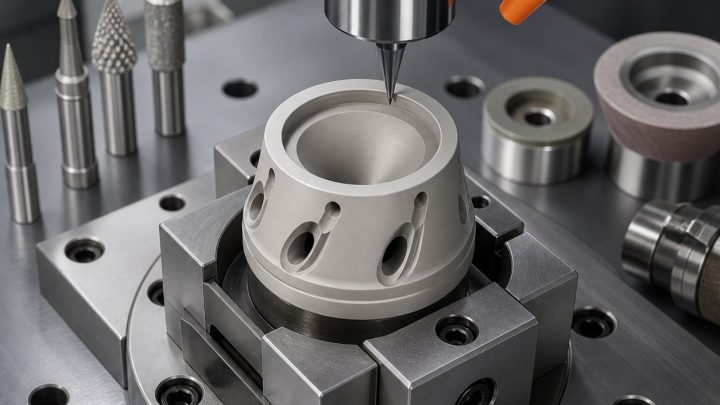
This hypothetical hub combines a stepped pilot bore, internal involute spline, locating face, outer seal land and cross-drilled lubrication hole. The drawing also specifies carburized zones and surfaces protected from case hardening. Tool selection must therefore serve both the soft-machining geometry and the post-heat-treatment datum recovery plan.
Functional datums and heat-treat map
Use the locating face as axial datum A and the pilot bore as radial datum B; clock the cross hole from a spline tooth or a defined external flat. Separate finished dimensions from pre-carburizing targets. Mark case-depth zones, stop-off areas and surfaces that retain grinding or hard-turning stock so the heat treater receives an unambiguous part.
Turning, boring and spline tools
Rough the OD and faces with a stable carbide insert, then use a positive-rake boring bar for the stepped pilot. Prepare the spline minor diameter and entry chamfer before broaching, shaping or power skiving with a suitable internal-spline cutter. A stub carbide drill opens the cross hole, and a back-chamfer tool removes the internal breakthrough burr.
Two-stage process plan
Soft-machine both face and bore in one setup, leaving balanced stock on datums intended for recovery. Cut the spline while the material is machinable, verify tooth thickness and runout, then drill and deburr lubrication features. After carburizing and controlled cooling, locate from protected or recoverable datums and finish only the specified seal land, face and pilot surfaces.
Distortion, edge and tool-life risks
Uneven section thickness can move the bore and face during carburizing. Excessive soft-machining stock raises heat-treat distortion, while too little leaves no cleanup. Monitor spline-cutter wear through tooth-thickness trend and surface tearing; verify spline fit with a functional gauge, bore runout to the spline axis, and cross-hole burrs using borescope or controlled probing.
FAQ
Why finish some datums after carburizing?
Heat treatment can move the bore and face; recoverable datums allow the final functional stack to be restored.
Should the internal spline be cut after hardening?
Usually the spline is produced in the soft state unless the drawing and available hard-finishing process explicitly require otherwise.
中文:解读 16MnCr5 内花键联轴器毂图纸
本假设联轴器毂包含台阶定位孔、渐开线内花键、轴向定位面、外圆密封带和横向润滑孔。图纸还规定渗碳区域与防渗表面,因此刀具和工序既要满足软加工几何,也要为热处理后的基准恢复预留方案。
功能基准与热处理分区
以定位端面作为轴向基准 A,以定位孔作为径向基准 B;横孔角向位置应相对某一花键齿或明确外部平面定位。区分最终尺寸和渗碳前目标,标出层深区域、防渗区域以及保留磨削或硬车余量的表面。
车削、镗削与花键刀具
外圆和端面粗加工采用稳定硬质合金刀片,台阶孔用正前角镗杆完成。拉削、插削或强力刮齿前先加工花键小径和入口倒角。横孔使用短型硬质合金钻,孔内贯通毛刺用反向倒角刀去除。
两阶段工艺路线
软加工阶段在一次装夹中建立端面和孔,并对热后恢复表面保留均匀余量。材料仍易切削时完成花键,检查齿厚与跳动,再加工并去毛刺润滑孔。渗碳和受控冷却后,以防渗或可恢复基准定位,只精加工图纸指定的密封带、端面和定位孔。
变形、刃口与寿命风险
截面厚薄不均会在渗碳时带动孔和端面偏移。软加工余量过大会增加热处理变形,过小则无法清理。通过齿厚趋势和表面撕裂监控花键刀具磨损;用功能量规检查配合,并复核定位孔相对花键轴线的跳动及横孔内部毛刺。
常见问题
为什么部分基准要在渗碳后精加工?
热处理会移动孔和端面,可恢复基准能重新建立最终功能尺寸链。
内花键是否应在淬硬后加工?
通常在软态完成,除非图纸和现有硬精加工工艺明确要求热后成形。
Français : lire le plan du moyeu cannelé en 16MnCr5
Ce moyeu hypothétique réunit un alésage pilote étagé, une cannelure intérieure, une face de positionnement, une portée de joint et un trou de lubrification. Les zones cémentées et protégées imposent une gamme en deux étapes.
Références et carte thermique
La face est A, l’alésage pilote B et le trou est indexé depuis une dent ou un méplat défini. Il faut séparer les cotes finales des cotes avant cémentation et identifier les surfaces avec surépaisseur de reprise.
Outils carbure et cannelure
Des plaquettes carbure usinent l’extérieur et une barre positive finit l’alésage. Le diamètre mineur et le chanfrein précèdent brochage, mortaisage ou skiving. Un foret court et un outil de chanfrein arrière nettoient le trou transversal.
Gamme en deux phases
Créer face et alésage au même montage, couper la cannelure à l’état tendre et vérifier épaisseur et faux-rond. Après cémentation, reprendre depuis des références protégées et finir seulement les surfaces spécifiées.
Déformation et contrôle
La cémentation peut déplacer face et alésage. Une surépaisseur équilibrée est essentielle; suivre l’usure de l’outil par l’épaisseur des dents et contrôler la cannelure avec un calibre fonctionnel.
FAQ
Pourquoi reprendre les références après traitement ?
Le traitement peut déplacer la chaîne fonctionnelle.
La cannelure doit-elle être taillée après trempe ?
Généralement non, sauf exigence explicite et procédé de finition dure disponible.
Русский: чтение чертежа ступицы с внутренними шлицами 16MnCr5
Условная ступица имеет ступенчатое посадочное отверстие, внутренние эвольвентные шлицы, установочный торец, наружный поясок и поперечный канал. Зоны цементации и защиты требуют двухэтапного маршрута.
Базы и карта цементации
Торец задает базу A, отверстие — B, поперечный канал индексируют от зуба или наружной лыски. Отделяют окончательные размеры от размеров до термообработки и отмечают припуски восстановления.
Точение и шлицевой инструмент
Наружные поверхности точат твердосплавной пластиной, отверстие — положительной расточной оправкой. Малый диаметр и фаску готовят до протягивания, долбления или силового скайвинга; внутренний заусенец канала снимают обратной фаской.
Два этапа маршрута
Торец и отверстие создают за один установ, шлицы режут в мягком состоянии и проверяют до цементации. После охлаждения деталь базируют по защищенным поверхностям и чистят только заданные посадки.
Деформация и контроль
Неравномерное сечение смещает отверстие при цементации. Припуск должен быть равномерным; износ шлицевого инструмента отслеживают по толщине зуба, а посадку проверяют функциональным калибром.
FAQ
Зачем восстанавливать базы после цементации?
Термообработка может сместить отверстие и торец.
Нужно ли резать шлицы после закалки?
Обычно нет, если чертеж не требует специальной твердой обработки.