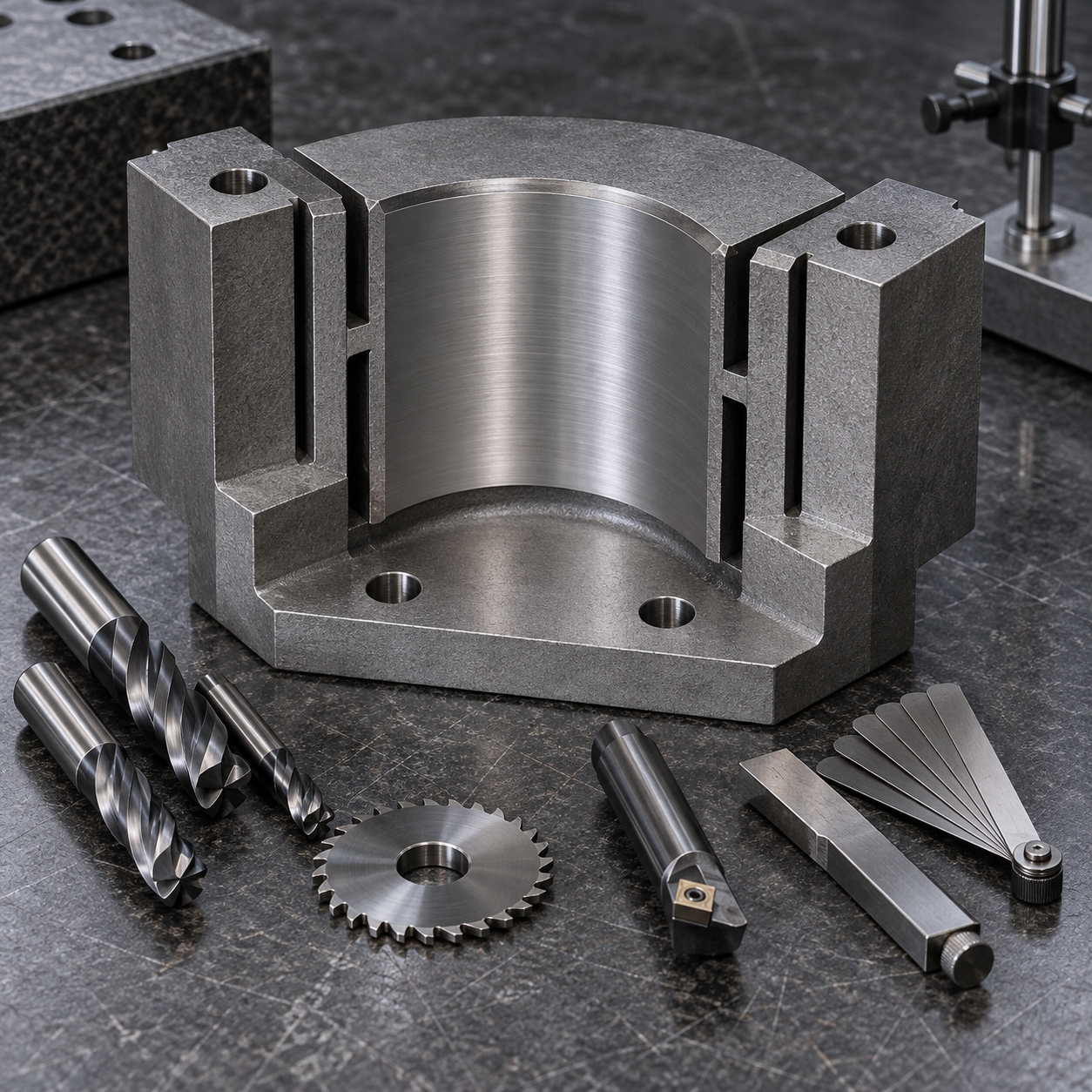
English: Hiperco 50 Pole-Shoe Tooling for a Lapped Air Gap and Thin Flux Bridges
The long-tail problem is how to machine a Hiperco 50 pole shoe so the lapped air-gap face stays concentric after narrow isolation slots release the thin flux bridges. The drawing links magnetic gap, bridge thickness, dowel position and post-stress-relief stock; dimensional accuracy alone is not enough.
Separate magnetic geometry from clamp geometry
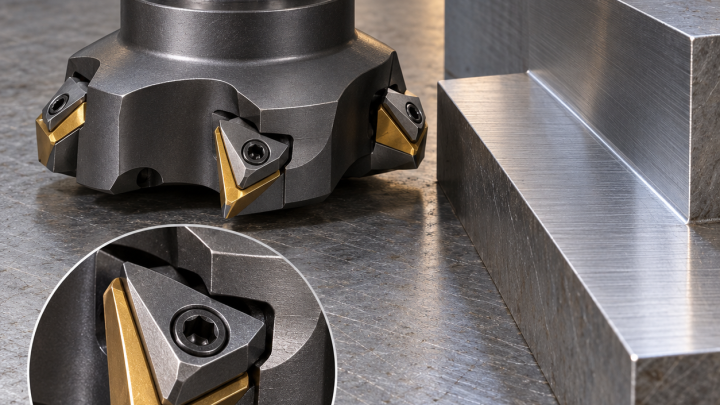
Clamp the annealed blank on broad soft jaws and face the mounting pad with a 50 mm fine-pitch cutter using sharp PVD carbide inserts. Rough the curved air-gap surface with a 10 mm five-flute AlTiN radius mill, leaving 0.12 mm for stress relief and lapping. Interpolate dowel bores with a 6 mm carbide mill before fine boring; a reamer is rejected because it follows positional error.
Feature-to-tool map for the pole shoe
| Drawing feature | Carbide tool and holder | Selection logic / rejected alternative |
|---|---|---|
| Mounting pad | 50 mm fine-pitch cutter, sharp PVD carbide, rigid arbor | Low force establishes the clamp datum; a coarse cutter bows the blank. |
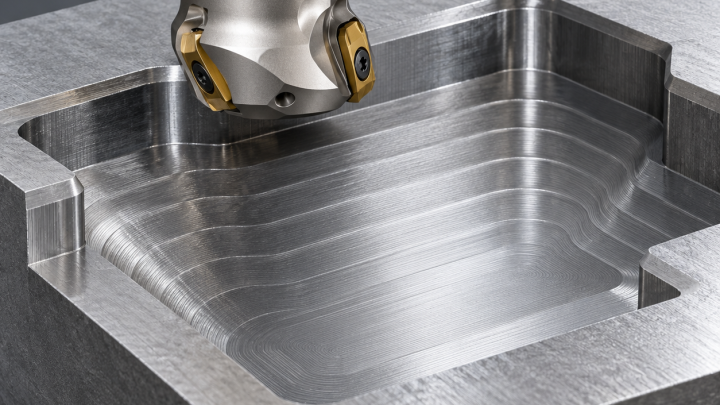
| Curved air gap roughing | 10 mm 5-flute AlTiN radius mill, hydraulic holder | Stable engagement and heat resistance; a ball mill leaves excessive cusp. |
| Dowel bores | 6 mm interpolation mill plus damped fine-boring head | Corrects position; a reamer follows the pilot. |
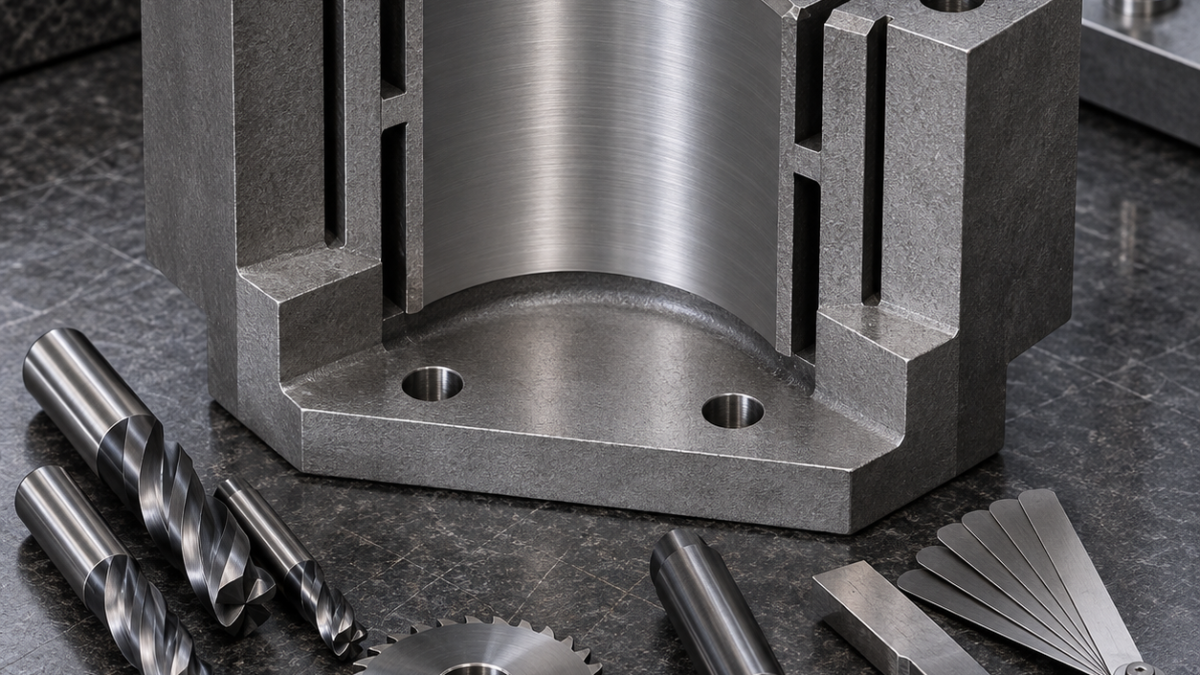
| Isolation slots | 1.2 mm fine-tooth carbide slitting cutter with bridge supports | Balanced side force; a long end mill bends. |
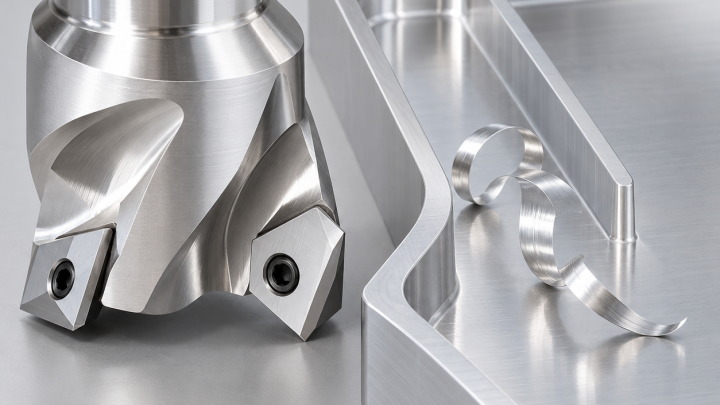
| Air-gap finish | 8 mm 6-flute variable-helix semifinish plus controlled form lap | Slot-release error is removed; polishing by hand rounds the arc. |
Build the air-gap reference before cutting bridges
After intermediate stress relief, relocate from the pad and dowels. Semifinish the air gap with an 8 mm six-flute variable-helix carbide tool in a hydraulic holder. Cut opposing isolation slots alternately using a 1.2 mm fine-tooth carbide slitting cutter with both bridges backed by sacrificial supports. A long narrow end mill is rejected because its bending force produces unequal bridge thickness.
Release isolation slots in a balanced sequence
Leave 0.03 mm for controlled form lapping of the air-gap face after slot release. Use nonmagnetic clean fixtures and collect chips so ferrous debris cannot score the lap. CMM verifies bore-to-arc location, an air-gap master or radius gauge checks the functional surface, and optical measurement records each bridge. Magnetic permeability or flux testing belongs after the specified final heat treatment, not as a claim from machining dimensions.
Related tooling comparisons: Invar optical-frame tooling; 440C encoder-disc tooling.
Hiperco pole-shoe FAQ
Why lap after slotting? Slots release stress and can move the arc. Why fine-bore dowels? The bore can correct position and size. Tool-life limit? Bridge-thickness drift, slot burr growth or a change in lapping stock distribution.