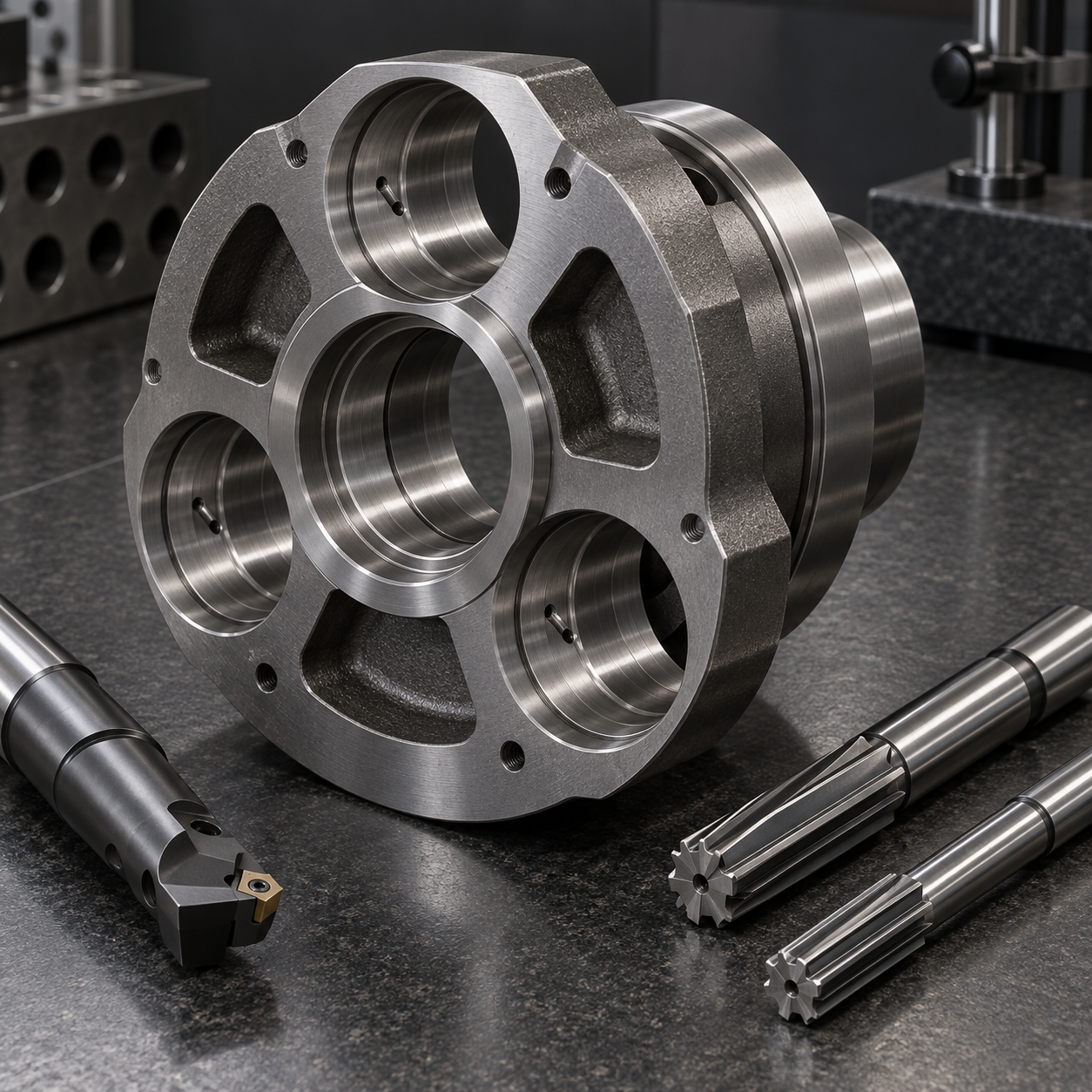
English: AISI 9310 Planetary Carrier Tooling for Pin Bores, Bearing Seats and Oil Jets
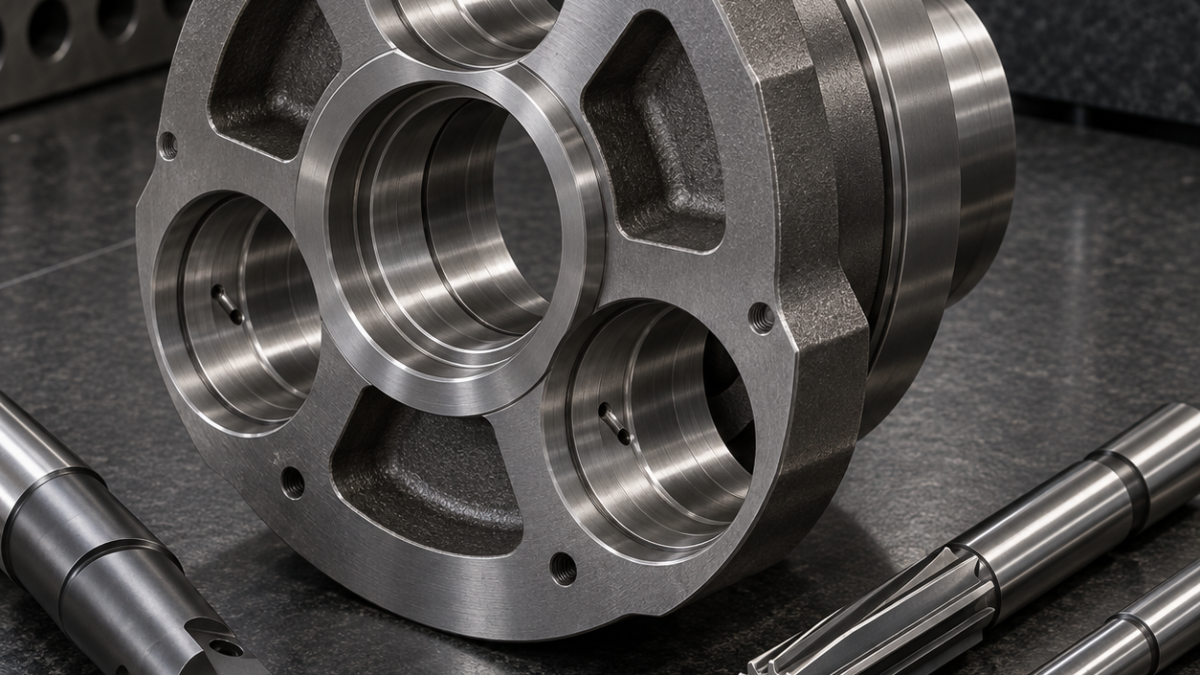
The drawing is a capability problem: three planet-pin bores must share position and axis quality while two bearing seats remain coaxial after carburizing. Instead of assigning one tolerance to one machine, the plan divides stock and measurement between soft machining, heat treatment and hard finishing.
Create a tolerance ladder across heat treatment
Face both thrust planes and rough the bearing seats in one horizontal-boring setup, leaving measured radial and axial stock. Interpolate the three planet bores with a 16 mm five-flute AlTiN rougher, then semi-bore them using the central pilot as the rotary datum. Witness pads record distortion after carburizing and define whether hard stock remains balanced.
Tool selection by capability gate
| Drawing feature | Carbide tool and holder | Selection logic / rejected alternative |
|---|---|---|
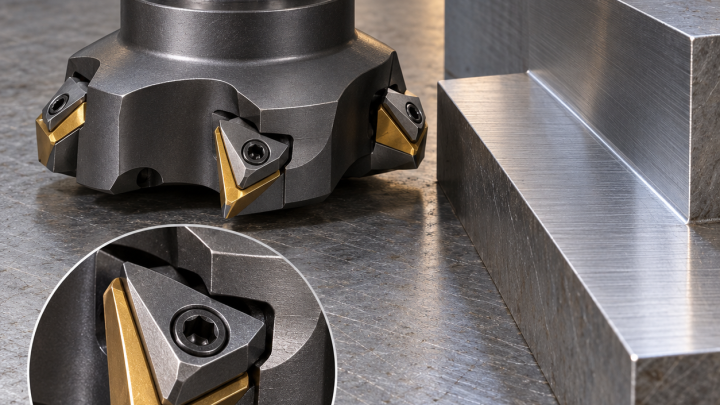
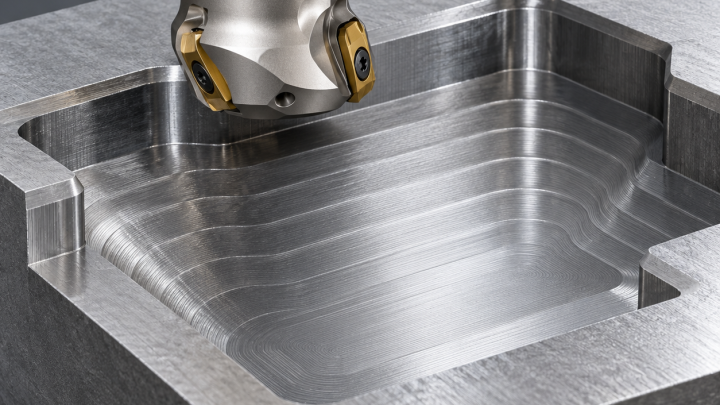
| Thrust faces and outer pilot | 80 mm indexable face mill with tough CVD inserts, dual-contact arbor | Balances axial stock; a small end mill creates thermal dish. |
| Soft planet-bore roughing | 16 mm 5-flute variable-pitch AlTiN end mill, hydraulic chuck | Adaptive interpolation controls load; plunge drilling cannot correct forged location. |
| Bearing seats after carburizing | CBN-tipped damped boring bar, minimum overhang | Holds coaxial axis; grinding each seat separately risks datum transfer. |
| Planet-pin bore finish | Fine-grain PVD carbide boring head; short multi-land reamer only for stable exits | Boring corrects position; reamer is reserved for size and texture. |
| Angled oil jets | 3 mm through-coolant carbide drill plus reverse chamfer tool | Clears chips and controls the intersection; a long HSS drill wanders. |
Rough the carrier while the ring is stiff
After heat treatment, support the web on three equal-height pads and clamp near the outer rim. A CBN boring bar finishes the two bearing seats without breaking the axis; the planet bores use a fine-grain PVD carbide boring head followed by a short carbide reamer only when the interrupted oil-jet intersection is absent. A reamer cannot correct position, so boring carries the geometry.
Finish hardened bores from one axis
Angle-drill each oil jet from the relieved web side with a 3 mm through-coolant carbide drill after semi-finishing but before final seat honing. Breakthrough is verified by borescope and flow, and a reverse chamfer removes the feather at the pin bore. Capability is accepted from common-axis CMM results, air-gauge size and roundness traces, not three independent plug-gauge passes.
Related tooling comparisons: eccentric journal datum control; robot flange bore alignment.
Planet-carrier machining FAQ
Why leave unequal stock deliberately? Measured carburizing movement may require location-specific correction. Can all bores be reamed? No; reaming follows the existing axis and reacts poorly to interrupted exits. Which tool-life signal matters? CBN notch wear at the case-depth boundary and rising bore-lobing amplitude.