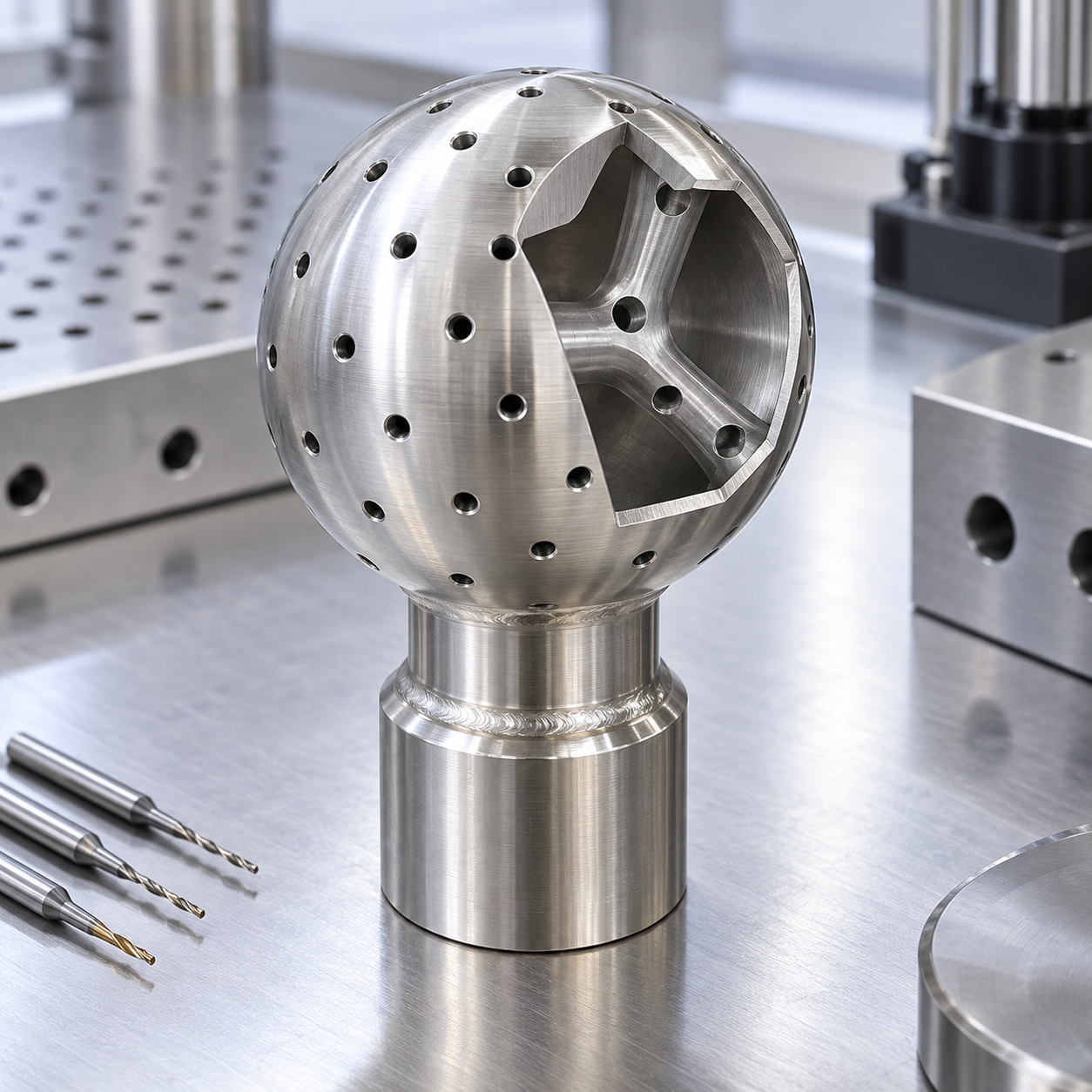
English: 316Ti CIP Spray Ball Tooling for Compound-Angle Micro Holes and Burr-Free Interiors
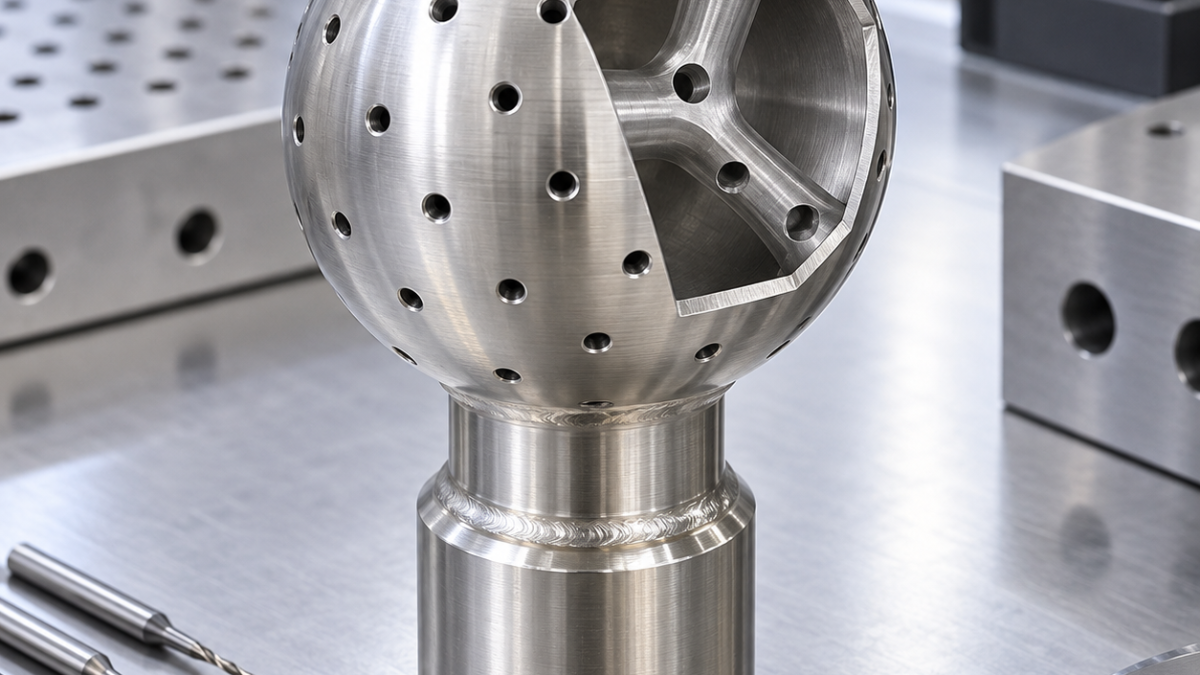
The search intent is how to drill a 316Ti CIP spray ball without changing its spray vectors or leaving internal burrs. The drawing controls each hole by two angles from the weld-neck axis, not by a flat pattern. Hole position, exit shape and the inaccessible internal edge therefore form one acceptance decision.
Build a spray-vector audit before cutting metal
Turn the weld neck, sealing shoulder and temporary spherical trunnion in one setup. A five-axis cradle then locates the neck in a split collet while the trunnion supports rotation. Probe the sphere at several latitudes and rotate the programmed vectors onto the measured center; locating every port from raw stock would accumulate shell error.
Feature-to-tool map for the hygienic sphere
| Drawing feature | Carbide tool and holder | Selection logic / rejected alternative |
|---|---|---|
| Weld neck and seal shoulder | Positive PVD-coated carbide turning insert, 0.4 mm nose radius, rigid Capto holder | Low radial force protects the thin shell; a broad wiper can bell-mouth the neck. |
| Spherical datum surface | 6 mm 4-flute variable-helix AlTiN ball end mill, shrink-fit holder | Stable five-axis contact; a large face mill cannot follow the sphere. |
| Compound-angle port start | 1.5 mm 140° AlTiN carbide spot drill, 3xD reach | Prevents skating without a wide countersink; a center drill rubs on the tangent. |
| 1.0 mm spray holes | Through-coolant micro-grain carbide drill, polished flute, 8xD | Clears chips in one vector; HSS flexes and work-hardens the exit. |
| Internal edge break | Miniature reverse-chamfer carbide tool or qualified abrasive flow | Controls retained burr; manual picking is not repeatable or hygienic. |
Index the sphere without losing the neck datum
Each port starts with a 1.5 mm 140-degree AlTiN carbide spot drill, followed immediately by a 1.0 mm through-coolant micro drill with polished flutes and a small controlled hone. Use one decisive feed through the inner wall and retract while coolant is flowing. A long peck cycle rubs 316Ti, while a zero-hone drill chips when it meets the curved skin.
Prevent work hardening at breakthrough
Verify diameter with optical focus at the outer ellipse, but accept direction from a calibrated pin or computed tomography line fit through the full wall. Borescope the interior and test a sample with filtered flow to reveal a flap that visual inspection misses. Tool life is limited by thrust trend and exit burr height, not by a fixed number of holes.
Related tooling comparisons: sanitary seal and bore tooling; angled cooling-hole strategy.
CIP spray-ball tooling FAQ
Can a ball end mill spot every angle? It creates a wide polished seat that changes the spray. How is the inner burr removed? Prefer a validated micro reverse-chamfer or controlled abrasive-flow cycle, never loose hand scraping. When is passivation performed? After burr inspection and final cleaning so residue cannot conceal a defective edge.
For the drill, holder, exit-support and burr-control decision behind this feature, use the Micro-hole decision hub.