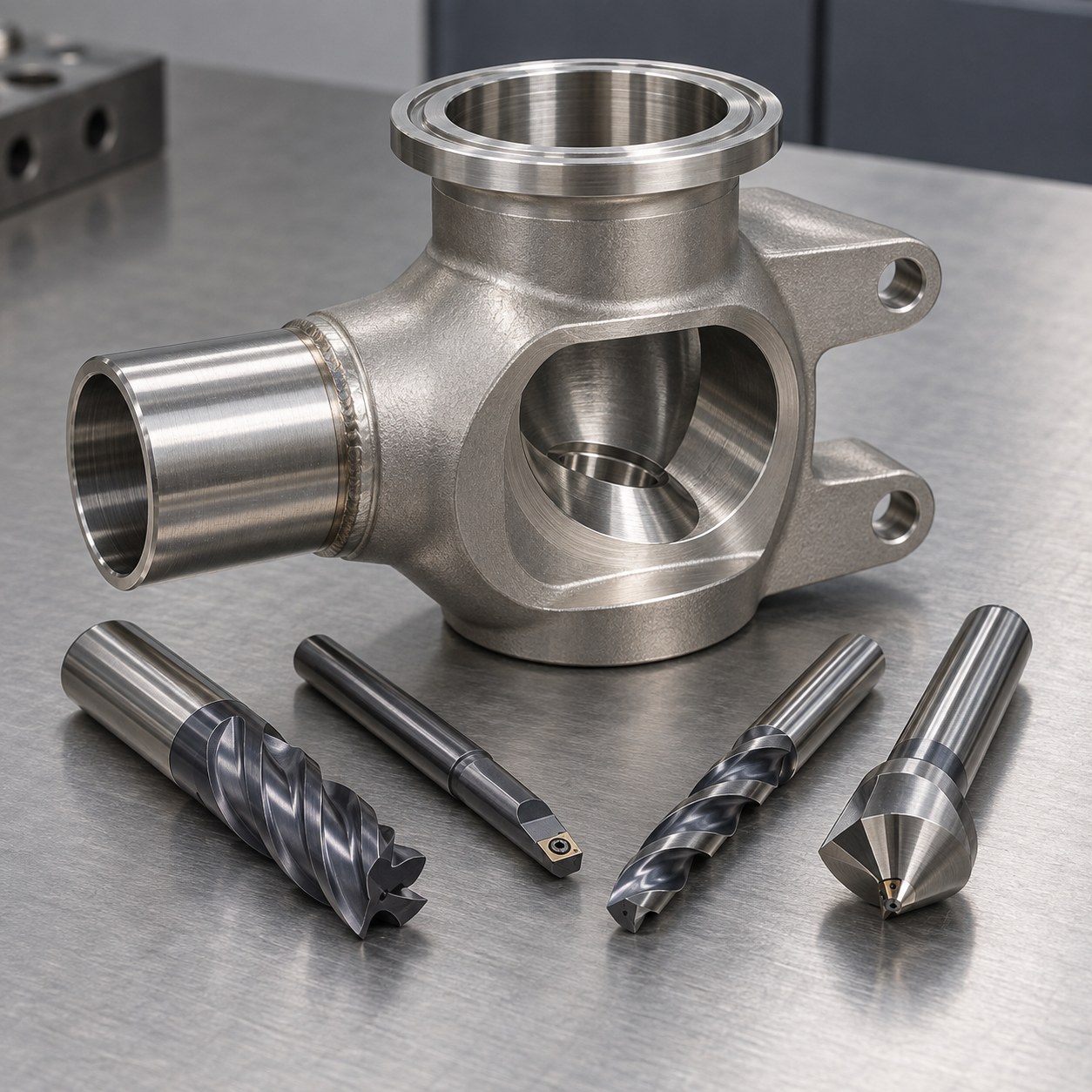
English: Alloy 20 Sampling Valve Tooling for Eccentric Seat and Weld Stub
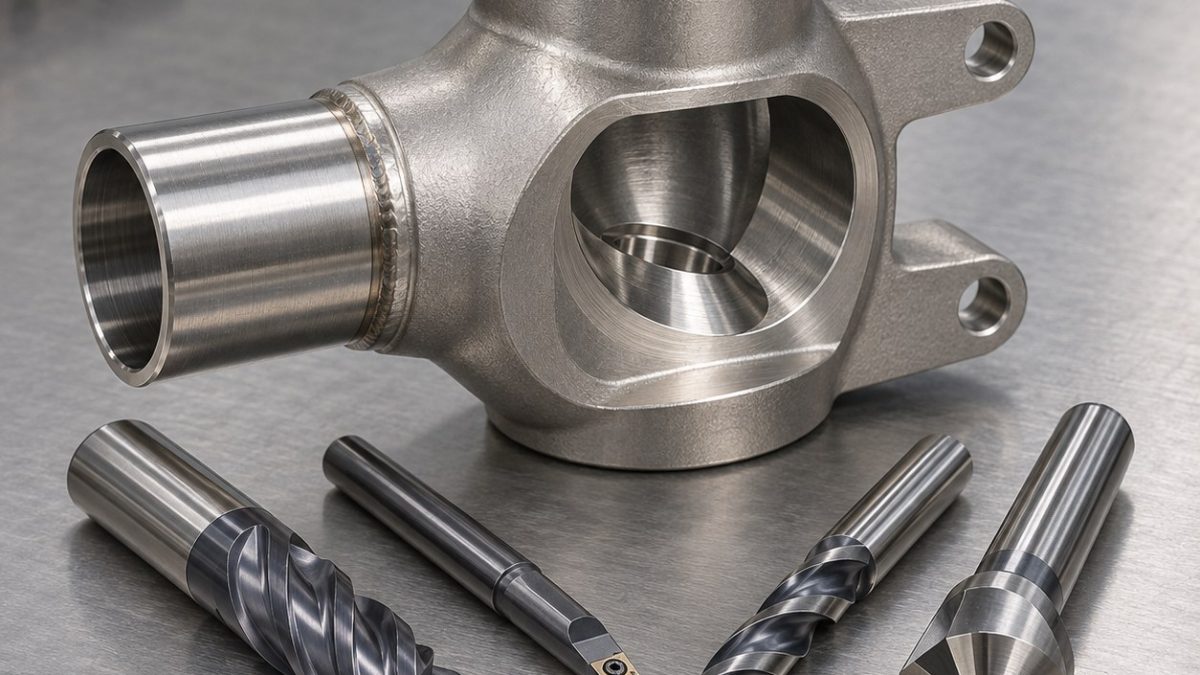
The long-tail intent is how to machine an Alloy 20 sampling-valve body without losing the relationship between an eccentric sealing cone and a thin orbital-weld stub. The drawing is read from the clamp face into the product pocket, then the seat axis is clocked from the two mounting holes. Values are hypothetical and do not certify sanitary service.
Build the hygienic datum chain
Face and rough the product bore while the casting is supported on soft jaws. Semifinish the pocket, probe the clamp datum, then rotate once to bore the eccentric seat. Finish the cone with a light form pass, turn the weld stub last with a sacrificial internal plug, and remove the plug before free-state measurement.
Map interrupted features to tools
| Drawing feature | Carbide tool and holder | Why selected / alternative rejected |
|---|---|---|
| Clamp face and product bore | 16 mm 5-flute variable-helix AlTiN carbide end mill in hydraulic holder | Helical interpolation keeps chip load positive; a long HSS drill rubs the nickel-rich alloy. |
| Eccentric sealing cone | Short fine boring bar with sharp PVD M-grade insert, then dedicated carbide form tool | Boring establishes the axis before the form pass; plunging the form tool into full stock chatters. |
| Orbital-weld stub OD and ID | Polished positive carbide turning inserts with 0.2 mm nose radius in rigid driven-tool setup | Low cutting force protects the thin tube; a large wiper radius pushes the wall out of round. |
| Side product pocket | 8 mm 4-flute unequal-pitch AlCrN end mill, reduced neck, shrink holder | Constant-engagement entry avoids a hardened notch; full-width slotting traps hot chips. |
| Mounting holes and edge breaks | Carbide spot drill, coolant-through drill and single-flute 45° chamfer mill | Spotting fixes clocking; hand deburring can roll material into the cleanable flow path. |
Prevent work hardening at the seat
Alloy 20 work-hardens when an edge dwells. Keep feed through pocket breakouts, use a tough sharp grade, and monitor notch wear at the exact seat depth. A bright smeared band, compact blue chip or rising spindle load triggers an edge and holder check before offsets are changed.
Inspect flow path after release
After unclamping, verify clamp-face flatness, seat-axis position, cone angle and weld-stub roundness. Use a borescope at the pocket-seat intersection and trace the flow-path blend. Surface texture and drainability are documented separately; this machining example is not a validation of cleanability.
Practical tooling FAQ
Why use a separate form tool only for the final cone?
Limiting its engagement lowers chatter and lets the boring bar establish seat location first.
Can the weld stub be finished before the pocket?
It is possible, but later clamping and interrupted cuts make thin-wall roundness less predictable.
AL-6XN Sterile Mixer Seal Housing CNC Tool Selection for Tandem Bores and Tangential CIP Port · C65500 Silicon Bronze Stern-Tube Seal Carrier CNC Tool Selection for Stepped Bore and Water Slots