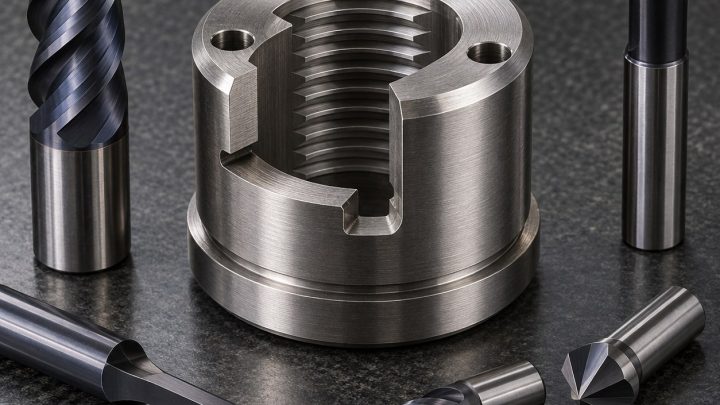

English: AL-6XN Seal Housing Tooling for Tandem Bores and CIP Port
The long-tail question is how to keep two seal bores coaxial after a tangential cleaning port breaks into the housing. The drawing is read from the product-side flange face through both bore shoulders; the CIP port is clocked later from the bolt-circle datum. Values are educational and do not certify hygienic service.
Protect the bore stack before port breakout
Rough the central cavity and stress-relieve by time and temperature only if the documented material route permits it. Semifinish both bores, leave equal stock, and finish them in one spindle orientation. Index from the bolt circle for the CIP port, interpolate through the wall with constant engagement, then use a light common-axis cleanup pass only if inspection shows movement.
Plan roughing, semifinishing and finishing
AL-6XN hardens rapidly when the edge rubs. Keep feed through the port breakout, avoid dwell on the bore shoulders, and maintain coolant delivery approved for the sanitary process. A bright smeared band, notch wear at depth or blue compact chips requires an edge and holder check before any offset change.
Choose tools at each drawing interruption
| Drawing feature | Carbide tool and holder | Why this choice / rejected alternative |
|---|---|---|
| Primary bore roughing | 32 mm indexable high-feed drill, PVD-coated tough carbide grade, through coolant | Keeps a positive chip load in AL-6XN; a long HSS drill rubs and work-hardens the wall. |
| Tandem bore semifinish | 16 mm 5-flute variable-helix AlTiN carbide end mill, radial interpolation, hydraulic holder | Leaves uniform boring stock; plunging a full-width cutter overloads the entry. |
| Seal-bore finish | Short anti-vibration boring bar with 0.4 mm wiper insert, PVD-coated M-grade, Capto holder | One bar references both lands; a reamer follows distortion after the port breaks through. |
| Tangential CIP port | 10 mm 4-flute unequal-pitch AlCrN carbide end mill plus coolant-through carbide drill | Helical interpolation limits notch wear; a long standard drill walks on the curved wall. |
| Drain scallop and bolt circle | 6 mm 4-flute carbide radius mill; carbide spot drill and coolant-through drills | Radius path avoids a sharp residue trap; spot first so drills do not skate on the flange. |
Verify texture, drainage and datum recovery
Measure the flange datum, both bore diameters, coaxiality and shoulder spacing after the port is complete. Inspect the port intersection with a borescope, verify the drain scallop with a contour trace, and record surface texture along—not across—the sealing direction. Cleanability and sterile service require separate validated tests.
Search-driven tooling FAQ
Why finish the tandem bores in one orientation?
It removes rotary indexing error from the common seal axis.
Can a borescope prove hygienic acceptance?
No. It finds burrs and discontinuities; validated cleaning tests remain separate.
PPS-GF40 Battery Isolation Comb CNC Tool Selection for Thin Tines and Vent Slots · Tantalum Sputtering Target Clamp Ring CNC Tool Selection for Stepped Seat and Relief Slots