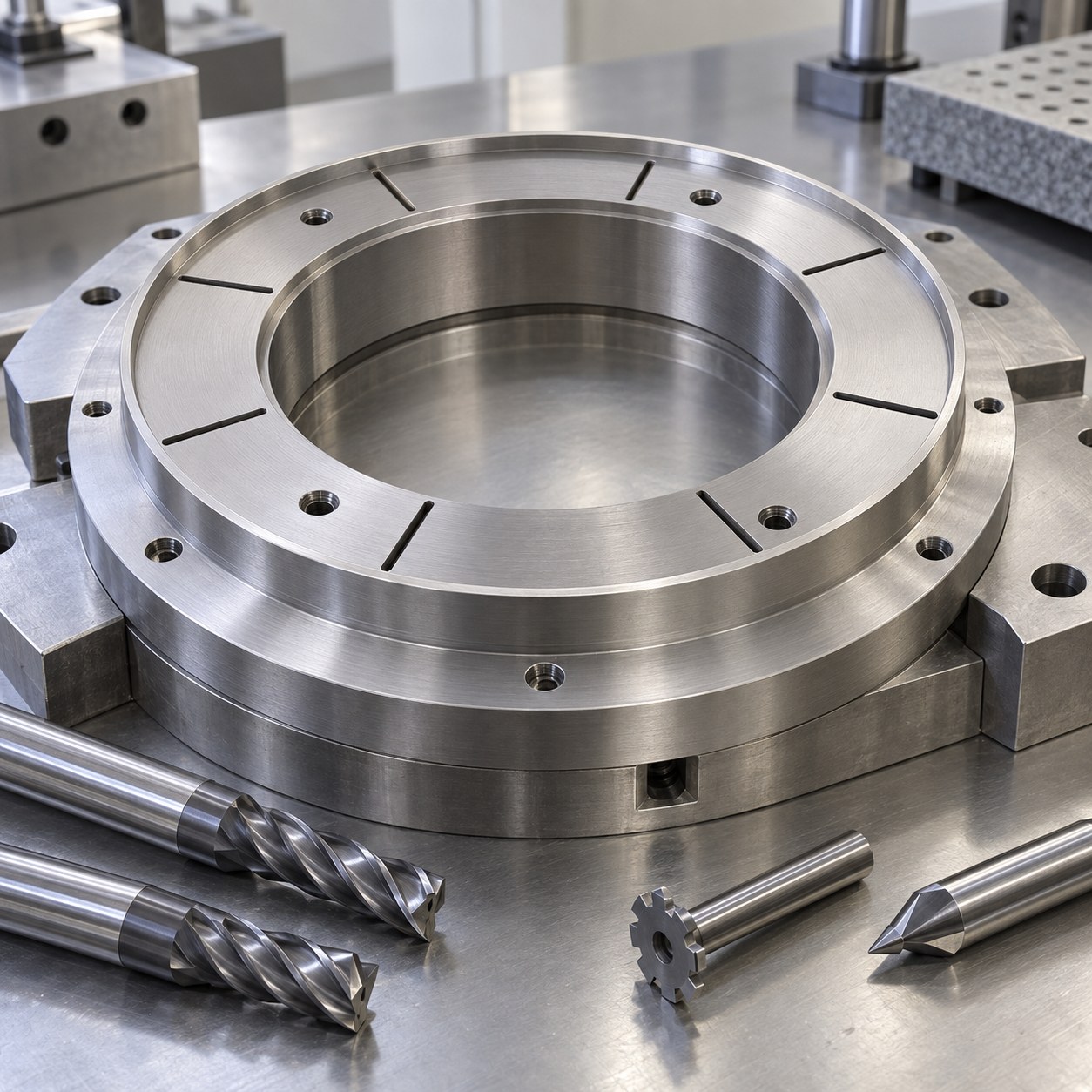
English: Tantalum Target Clamp Ring Tooling for Stepped Seat and Relief Slots
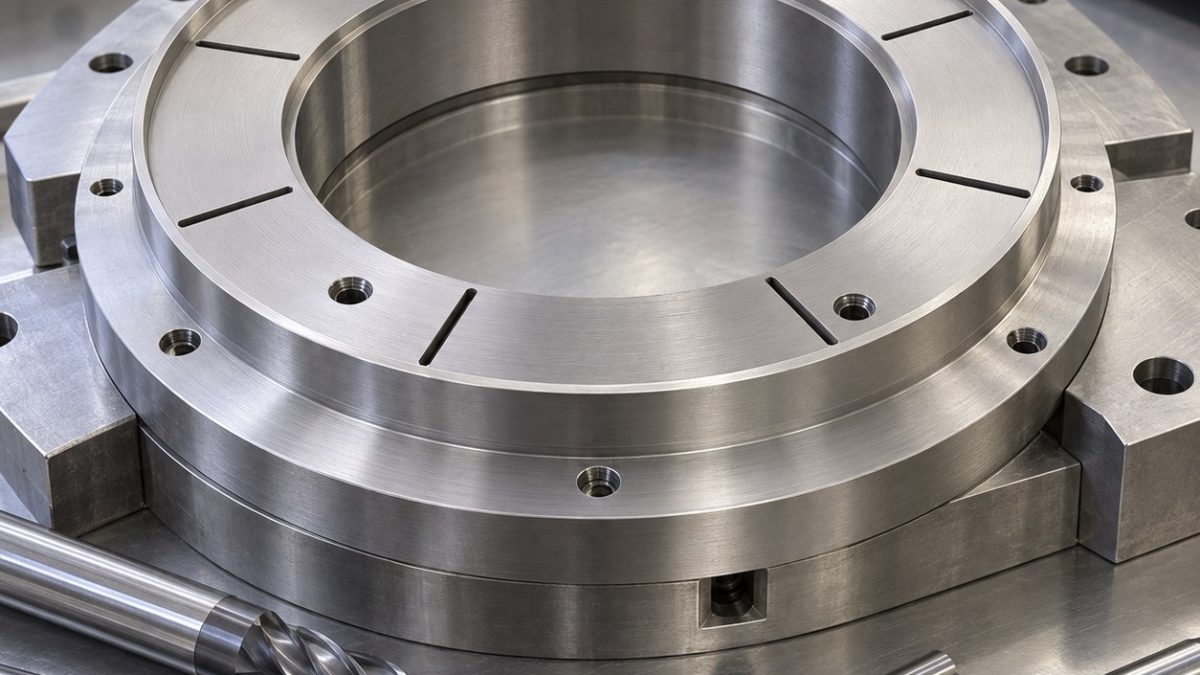
A tantalum target-retaining ring is a poor place to accept a rolled burr: the inside step establishes the target edge, while narrow radial reliefs allow the outer band to flex. In this hypothetical drawing, datum A is the stepped inner seat, datum B the lower face, and a 0.05 mm free-state roundness callout governs the finished ring. The 0.7 mm lip and 1.2 mm relief widths are illustrative values. Tool choice must keep the seat clean without using the lip as a clamp.
What the datum scheme changes
Use an expanding mandrel on a sacrificial outer land for the first operation. Face B and rough the inner step before opening the relief slots. After the seat is semi-finished, transfer to a broad-face support ring; clamp through the bolt region with limited pressure, never on the 0.7 mm lip. Finish A in this stable setup and use it to orient the radial pattern.
Tool choice at each feature
| Print feature | Selected carbide and holder | Decision and rejected option |
|---|---|---|
| Annular rough stock | 10 mm two-flute polished uncoated fine-grain carbide end mill, positive rake, hydraulic holder | Low radial engagement and steady lubricated chip flow; a dry four-flute steel rougher invites adhesion. |
| Stepped datum seat A | Positive-rake polished carbide turning insert with minimal edge hone, short boring bar | Semi-bore then finish in a continuous pass; a large nose radius pushes the thin inside lip. |
| Radial relief slots | 1.0 mm two-flute sharp carbide slot mill, relieved neck and minimum 5 mm reach, precision collet | Cut alternating slots with supported exits; a wider slot saw cannot hold individual root radii. |
| Bolt-circle holes | Carbide 90° spot drill, 3 mm two-flute drill and 45° micro-chamfer cutter | Spot first and drill into a backed surface; hand countersinking can lift a soft exit burr. |
| Final rim and lip break | 6 mm polished two-flute carbide finisher and tiny-radius carbide chamfer mill | A measured edge break avoids a rolled lip; abrasive hand cleanup hides tearing. |
Prevent adhesive wear rather than polishing it away
Tantalum is ductile and can adhere to a worn edge. Use a cutting fluid approved for the chamber cleanliness requirement, with continuous flow at the cutter; collect chips so they cannot be recut across the seat. Avoid dwell in a relief root. Inspect the cutting edge after the first slot and at fixed intervals; a smeared seat, rising torque or stringy lip burr is a stop signal, not an invitation to reduce feed until the tool rubs.
Release, measure and document
After unclamping, measure A-to-B perpendicularity, the step diameter and the free-state roundness. A profile projector or optical microscope checks slot width and root radius; pin gauges check the holes and a tactile check is kept away from the thin lip. Record surface finish on the seat using the drawing's specified method, not a guessed Ra target. Chamber cleanliness and target retention remain separate acceptance tests.
Workshop FAQ
Why not finish all slots before the seat?
Removing a full set of slots changes ring stiffness; reserve the final seat pass for the supported condition.
Can a coated carbide tool be used?
It may be qualified, but edge sharpness and adhesion under the selected lubricant must be proven on this grade first.
Where is the first burr check?
At the slot exits and inner retaining lip, before the next slot hides a change in cutter condition.
Related tooling decisions: Niobium RF Cavity Flange CNC Tool Selection for Seal Land and Thin Weld Lip; Molybdenum Heat-Shield Cup CNC Tooling Case: Deep Blind Bore and Thin Lip.