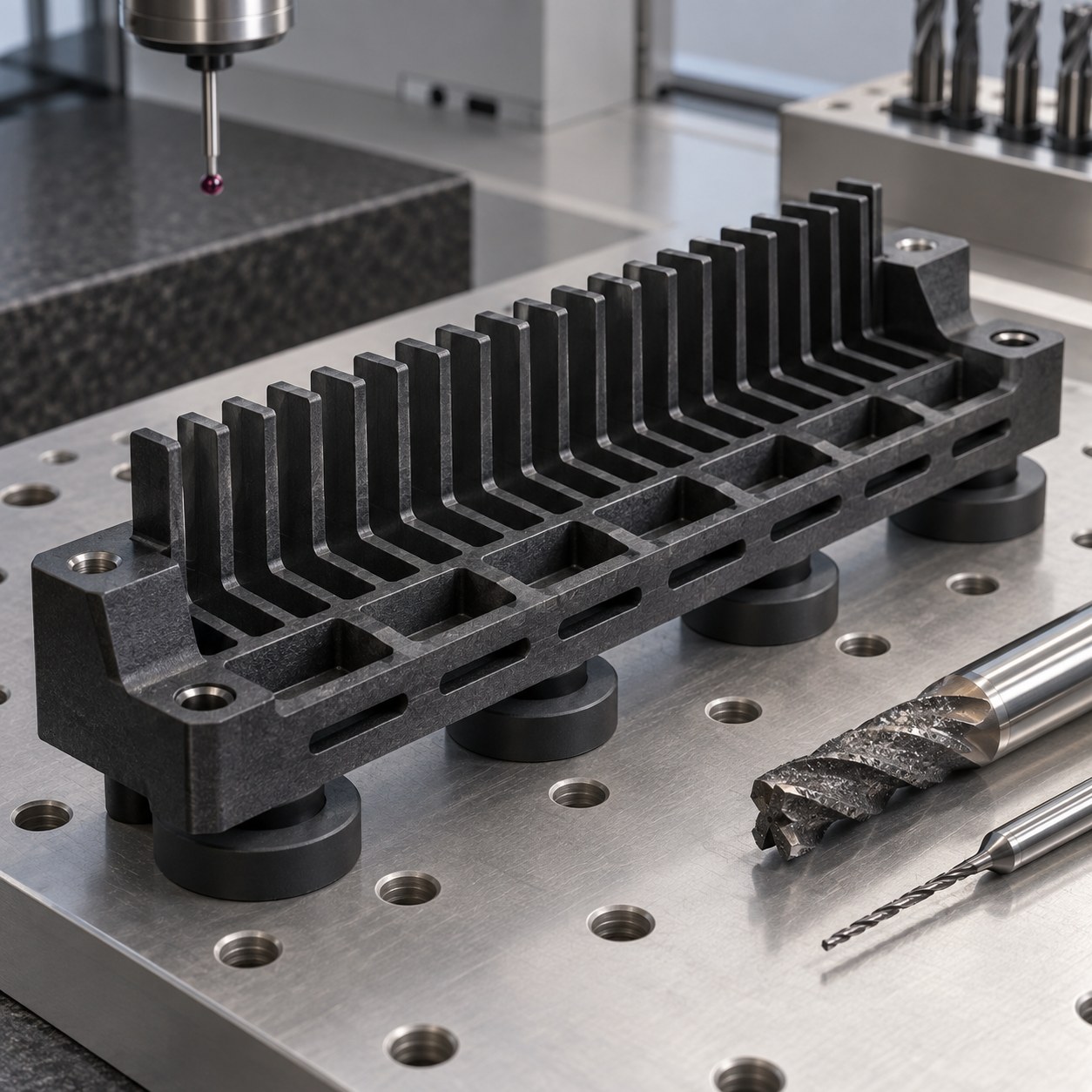
English: PPS-GF40 Battery Isolation Comb Tooling for Thin Tines and Vent Slots
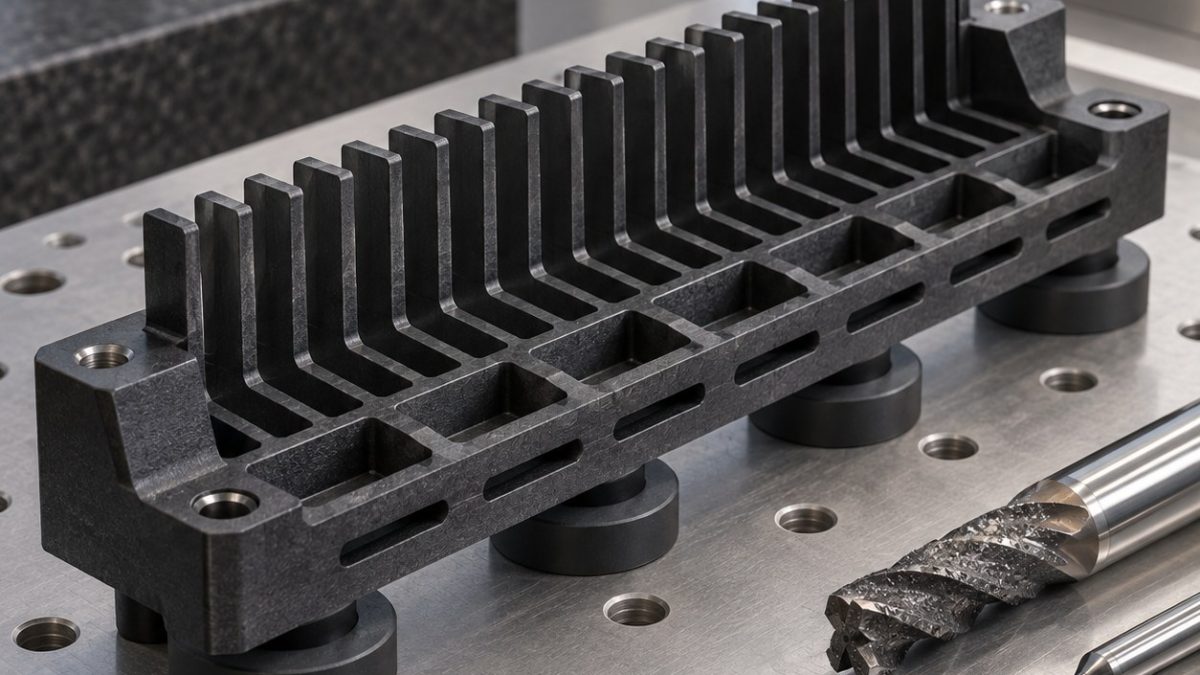
A PPS-GF40 isolation comb should be judged by its thin tines after the holding plate comes off. In this hypothetical battery-module drawing, each tine separates adjacent cell envelopes, shallow pockets locate them, and side vents give an intended escape path. A 1.4 mm minimum tine, 0.08 mm pitch tolerance over the row and 0.05 mm seating-face flatness are example values. Glass-filled PPS is stiff but its reinforcement abrades small cutters and an unsupported tine may chip at the root.
Where each cutter earns its place
| Feature and risk | Tool package | Rejected shortcut |
|---|---|---|
| Top datum and bulk pockets | 6 mm two-flute diamond-coated carbide end mill, short shrink holder, low radial engagement | Wear-resistant roughing; a high-flute steel mill traps abrasive dust and dulls rapidly. |
| Tine gaps | 2 mm two-flute diamond-coated carbide neck-relieved cutter, only enough reach for depth | Alternate gaps and preserve support. Full-depth slotting with a long microcutter fractures the root. |
| Tine sidewall finish | 2 mm sharp fine-grain uncoated carbide finisher reserved for limited final passes | A fresh edge limits exposed fiber; its short life is monitored rather than assumed. |
| Vent slots | 1 mm diamond-coated two-flute carbide slot mill with dust extraction at cut | Multiple shallow passes prevent root breakout; a saw blade cannot steer the narrow openings. |
| Mounting holes and edge break | 2.5 mm carbide drill with backing, 60° single-flute carbide chamfer mill | Support hole exits and keep chamfer small; manual knife cleanup can peel fibers. |
Read the final free-state envelope
The drawing's datum A is the continuous underside, while the two end holes define row position. First face A and machine the locator pockets while the stock still supports the teeth. Fasten through the sacrificial perimeter to a flat porous support; avoid direct clamps on the narrow tines. Leave a thin bridge at the tips during gap roughing, release the stresses, then remove bridges and finish sidewalls in alternating order.
Abrasive fiber and dust alter tool life
Use local extraction suitable for the reinforced polymer, with a chip stream that does not blow dust back into the open pockets. Diamond coating buys abrasion resistance in bulk removal, but edge buildup or a rounded coating can still chip the thin ends. Inspect a reference tine under magnification at fixed intervals; visible fiber pullout, rising cutting force or pitch drift ends the tool interval. Reduce step-down before reducing feed into rubbing.
Inspect against the cell envelope
After removing the support, check flatness of A and tine pitch by vision over the whole row, not only at one gap. Gauge pocket depth and vent openness, then inspect roots and drilled exits for cracks or protruding fibers. A mating dummy cell checks entry force without claiming electrical safety from geometry alone. The insulation and thermal requirements must be validated by the product specification.
Workshop FAQ
Why use two tools on the tine walls?
A wear-resistant rougher preserves productivity; a fresh sharp finisher protects the exposed fiber edge.
Can the tines be clamped directly?
No; their free-state position would be hidden by clamping deflection.
Does a burr-free appearance prove insulation?
No; electrical acceptance belongs to a separate specified test.
Related tooling decisions: PEEK-GF30 Rotary Valve Rotor CNC Tool Selection for Seal Lands and Curved Metering Slots; PBT-GF30 Connector Inspection Nest CNC Tool Selection for 0.60 mm Pin Pockets.