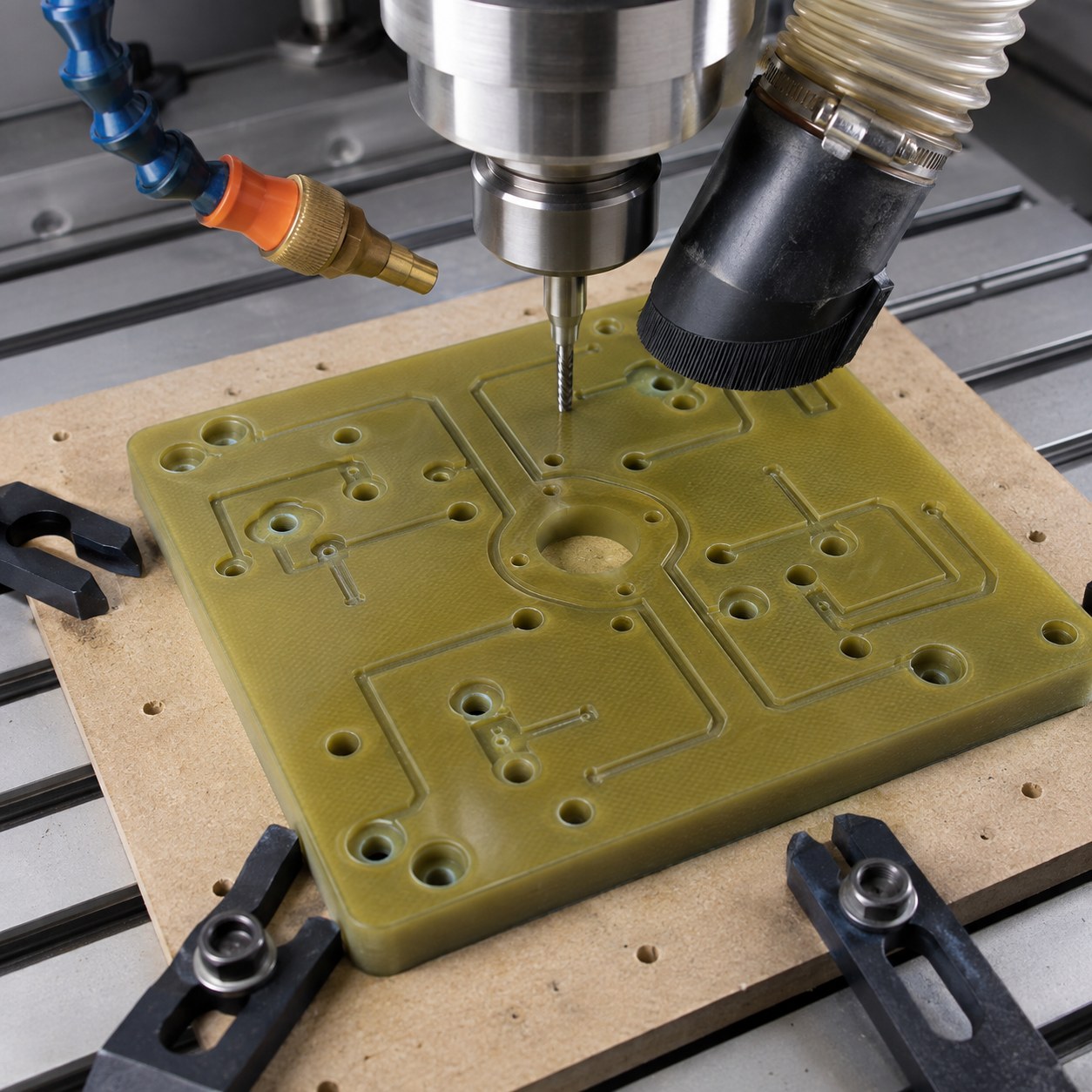
Related drawing references: Rene 41 Turbine Seal Segment CNC Tool Selection for Honeycomb Pocket and Feather Edges and C70600 Condenser Tube Sheet CNC Tool Selection for Dense Bore Array and Tube-Retention Grooves.
English: G10 Epoxy Glass Manifold Tooling for Sealed Channels and Counterbored Holes
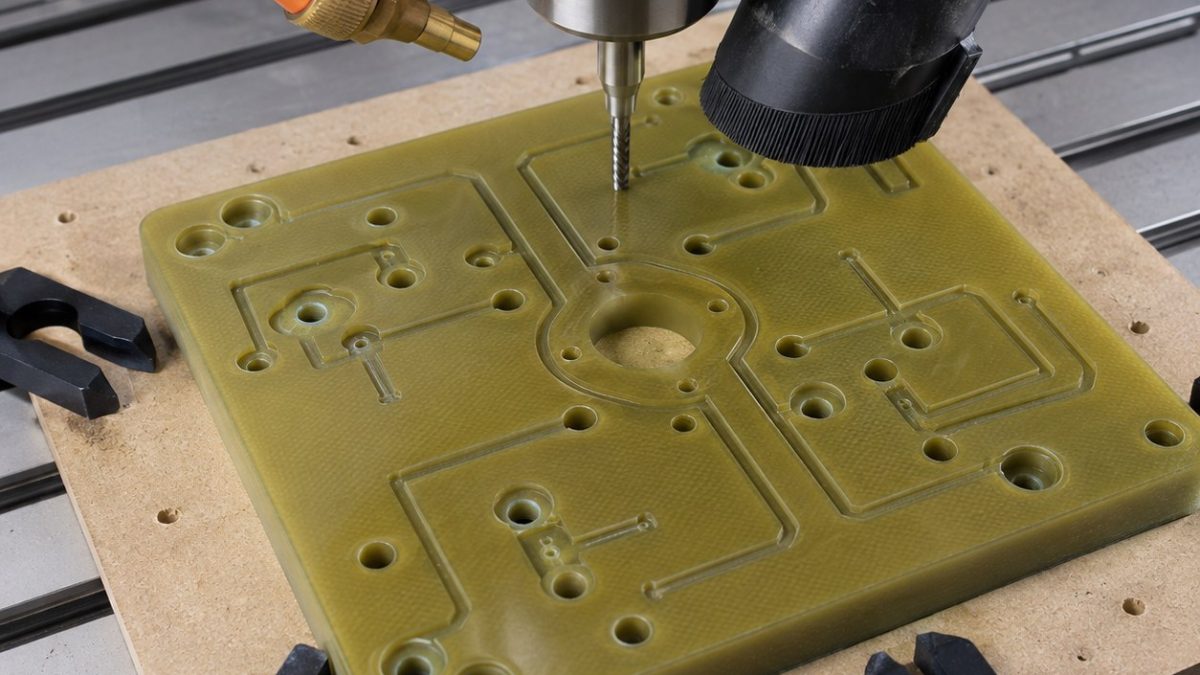
For this G10 manifold, the drawing is dominated by sealed channel reliability, not by simple pocket milling. Tool choice must stop glass-fiber breakout before the gasket line is measured, because loose strands can create a leak path even when the width is within tolerance.
Feature-to-tool selection from the drawing
| Drawing feature | Selected tool and holder | Tooling reason and rejected option |
|---|---|---|
| Outer profile | 6 mm diamond compression router, neutral helix balance, dust shoe | Compresses top and bottom fibers; a standard end mill would lift glass strands. |
| Sealed channels | 3 mm diamond-coated two-flute router, short reach, climb finishing pass | Controls wall fuzz and corner size without smearing epoxy. |
| Counterbored holes | Carbide brad-point drill followed by diamond-coated counterbore | Separates axial drilling from laminate surface cleanup. |
| Gasket steps | 4 mm polished PCD-tipped router with shallow radial engagement | Holds sealing width and avoids heat-softened resin. |
| Vent breakouts | Reverse single-flute chamfer tool over sacrificial backer | Cuts fibers from both sides so loose whiskers do not remain in the channel. |
Process order, roughing and finishing
Mill the outside while the blank is bonded to a flat backer, cut channels in two depth stages, then drill and counterbore before the gasket step finish pass. Dust extraction stays active during every laminate cut and the backer is replaced when exit burrs begin to print through.
Material risk, chips and tool life
G10 produces abrasive dust and springy glass fibers. Tool life is judged by wall fuzz, spindle load and exit-whisker length, not by part count alone. Dry cutting is acceptable only with strong extraction; coolant is avoided because trapped moisture can mask fiber lift.
Tolerance, finish and inspection plan
Check channel width, floor witness marks, counterbore seating, fiber lift under oblique light and leak path continuity. A clean compressed-air pass is followed by visual inspection because trapped dust can look like a machining burr.
FAQ for this tooling case
Why use a compression router on G10?
It cuts the top and bottom glass layers toward the core, so edge fibers are not lifted into the seal path.
Should G10 be cut wet?
For this sealed manifold, dry cutting with extraction is cleaner because moisture can hide lifted fibers.
What makes the channel pass inspection?
Width, floor finish and the absence of loose fiber paths must all pass, not width alone.