Related drawing references: ETFE Diaphragm Support CNC Tool Selection for Spiral Flexure and Raised Sealing Bead and Rene 41 Turbine Seal Segment CNC Tool Selection for Honeycomb Pocket and Feather Edges.
English: 410 Stainless Pump Impeller Tooling for Thin Blades and Balance Pads
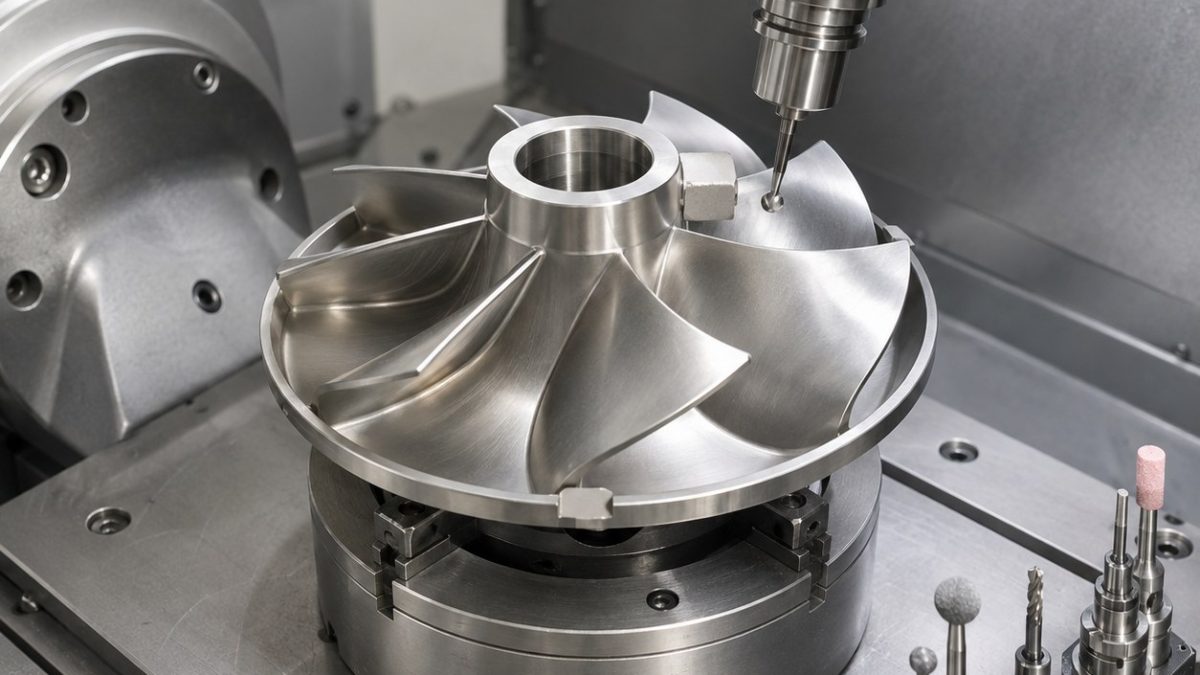
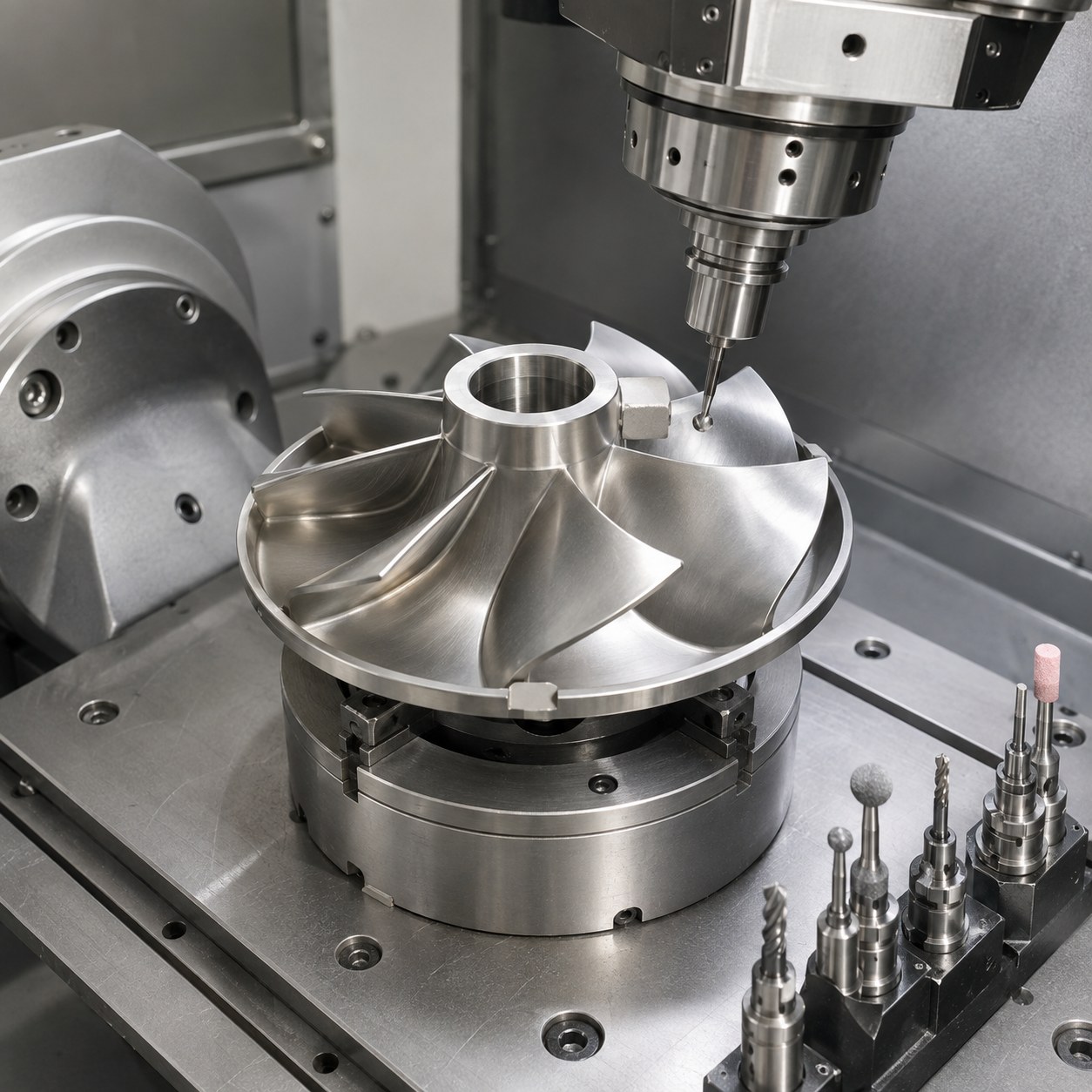
This impeller case answers a five-axis tooling question: how to finish thin 410 stainless blades while keeping the hub bore, shroud lip and balance pads tied to one measurable datum chain. Cutter pressure, holder reach and hidden burr access decide the route.
Feature-to-tool selection from the drawing
| Drawing feature | Selected tool and holder | Tooling reason and rejected option |
|---|---|---|
| Hub bore and datum | Boring head with TiAlN carbide insert and hydraulic holder | Locks the rotary axis before blade finishing; interpolation alone risks lobing. |
| Blade roughing | 8 mm high-helix 5-flute carbide, variable pitch, trochoidal entry | Controls heat and chatter while leaving even blade stock. |
| Blade surface finish | 10 mm barrel cutter plus 4 mm ball mill for root access | Uses the barrel cutter where possible and reserves the ball tool for tight radii. |
| Thin shroud lip | 3 mm corner-radius carbide, alternating light passes, long-reach shrink holder | Limits radial pull; a heavy slotting pass would spring the lip. |
| Balance pads and deburr | Small carbide end mill plus lollipop deburr tool | Machines removable pads and breaks hidden blade exits without filing. |
Process order, roughing and finishing
Rough the hub and back face first, finish the bore, then use five-axis indexed roughing between blades with equal stock left on both sides. Barrel finishing follows the blade mid-span, ball finishing cleans root radii, and balance pads remain oversize until after dimensional inspection.
Material risk, chips and tool life
410 stainless can chatter and locally harden when the blade vibrates. Maintain constant chip load, avoid dwell at the shroud lip, and replace finish tools when load trend changes before a burr appears. Air blast plus directed coolant keeps chips out of blade roots.
Tolerance, finish and inspection plan
CMM verifies bore axis, blade thickness at three spans, shroud lip runout and balance-pad stock. A borescope checks hidden exits, while a light spin check confirms no blade rub before dynamic balancing.
FAQ for this tooling case
Why combine barrel and ball tools?
The barrel cutter shortens open blade finishing, while the ball mill reaches tight root radii without forcing a long small tool everywhere.
How is thin-blade chatter controlled?
By equal stock, constant chip load, alternating passes and holder reach matched to each blade zone.
When are balance pads finished?
After bore and blade inspection, so material remains available for final balancing correction.
中文: 410不锈钢泵叶轮薄叶片与平衡台配刀
这个叶轮案例解决的是五轴配刀问题:410不锈钢薄叶片、轮毂孔、护圈薄唇和平衡台必须落在同一可测基准链内,刀具压力、伸出和隐藏毛刺决定工艺。
图纸特征到刀具的配刀表
| 图纸特征 | 选用刀具与刀柄 | 配刀理由与淘汰方案 |
|---|---|---|
| 轮毂孔与基准 | 精镗头配TiAlN硬质合金刀片和液压刀柄 | 先锁定旋转轴线;只靠插补易产生多边形误差。 |
| 叶片开粗 | 8 mm五刃变螺旋高螺旋硬质合金刀,摆线进刀 | 控制热和振动,并保留均匀叶片余量。 |
| 叶片精修 | 10 mm桶形刀加4 mm球刀处理根部 | 能用桶刀减少刀路,紧小圆角才用球刀。 |
| 护圈薄唇 | 3 mm圆角硬质合金刀,热缩长柄,交替轻切 | 降低径向拉力;重槽铣会弹开薄唇。 |
| 平衡台与去毛刺 | 小径硬质合金刀加棒棒糖去毛刺刀 | 加工可去除平衡台,并处理隐藏出口。 |
加工顺序、粗加工与精加工
先粗加工轮毂和背面,精镗中心孔后再按五轴分度开粗叶间通道,两侧保留等量余量。桶形刀精修叶片中段,球刀处理根部圆角,平衡台等尺寸检测后再修。
材料风险、排屑与刀具寿命
410不锈钢薄叶片振动时会啸叫并局部硬化。保持恒定切屑厚度,护圈薄唇处避免停顿;负载趋势变化就换精刀,不等毛刺出现。气吹加定向冷却清理根部切屑。
公差、粗糙度与检测计划
CMM检测中心孔轴线、三段叶片厚度、护圈跳动和平衡台余量;内窥镜检查隐藏出口,动平衡前先做低速旋转确认无擦碰。
本案例常见问题
为什么桶形刀和球刀组合?
桶形刀减少开放叶面刀路,球刀只处理根部小圆角。
薄叶片怎么控振?
靠等量余量、恒定切屑厚度、交替走刀和分区刀柄伸出控制。
平衡台什么时候加工?
孔和叶片检测后再修,保留动平衡修正余量。
Español: Herramientas para impulsor 410 con álabes finos
El caso responde a una pregunta de cinco ejes: cómo acabar álabes finos de acero 410 manteniendo agujero central, aro y pads de equilibrado en la misma cadena de referencia.
Selección de herramienta según el plano
| Elemento del plano | Herramienta y portaherramientas | Motivo y opción descartada |
|---|---|---|
| Agujero central | Cabezal de mandrinado con inserto TiAlN y portaherramientas hidráulico | Fija el eje antes del acabado de álabes. |
| Desbaste de álabes | Carburo 8 mm, 5 labios, hélice alta variable, entrada trocoidal | Controla calor y vibración con reserva uniforme. |
| Acabado de superficie | Fresa barril 10 mm y bola 4 mm en raíces | La barril reduce pasadas; la bola queda para radios cerrados. |
| Labio fino | Fresa tórica 3 mm en portaherramientas térmico, pasadas alternadas | Limita la tracción radial. |
| Pads y desbarbado | Fresa pequeña de carburo y herramienta tipo piruleta | Forma pads removibles y rompe rebabas ocultas. |
Orden de proceso, desbaste y acabado
Se desbasta primero cubo y dorso, se acaba el agujero central y luego se desbastan pasos entre álabes con reserva simétrica. La fresa barril acaba el tramo medio y la bola limpia raíces.
Riesgo del material, viruta y vida de herramienta
El acero 410 vibra y se endurece localmente. Mantener carga de viruta, evitar paradas en el aro y cambiar herramienta cuando cambie la tendencia de carga antes de la rebaba.
Tolerancias, acabado e inspección
La CMM verifica eje, espesor en tres zonas, descentramiento del aro y reserva de pads. Un boroscopio revisa salidas ocultas antes del equilibrado.
Preguntas frecuentes
¿Por qué barril y bola?
La barril reduce pasadas abiertas y la bola llega a radios cerrados.
¿Cómo controlar vibración?
Reserva simétrica, carga constante, pasadas alternadas y alcance correcto.
¿Cuándo acabar pads?
Después de inspección para conservar material de equilibrado.
Français: Outils pour roue de pompe 410 à aubes minces
Ce cas traite un choix cinq axes : finir des aubes minces en inox 410 tout en reliant alésage, lèvre et plots d’équilibrage à la même chaîne de référence.
Choix d’outil à partir du plan
| Élément du plan | Outil et attachement | Raison et option écartée |
|---|---|---|
| Alésage de moyeu | Tête d’alésage, plaquette TiAlN et attachement hydraulique | Fixe l’axe avant les aubes. |
| Ébauche des aubes | Fraise carbure 8 mm, 5 dents, hélice variable, entrée trochoïdale | Limite chaleur et broutage. |
| Finition aubes | Fraise tonneau 10 mm puis boule 4 mm aux racines | Réduit les passes et garde l’accès aux rayons. |
| Lèvre mince | Fraise torique 3 mm en attachement fretté, passes alternées | Réduit la traction radiale. |
| Plots et ébavurage | Petite fraise carbure puis outil ébavureur sphérique | Usine les plots et casse les bavures cachées. |
Ordre de gamme, ébauche et finition
Ébaucher moyeu et face arrière, finir l’alésage, puis ébaucher entre aubes en cinq axes avec une surépaisseur symétrique. La tonneau finit la portée principale et la boule les rayons.
Risque matière, copeaux et durée de vie
L’inox 410 vibre et s’écrouit localement. Garder une charge copeau constante, éviter les arrêts sur la lèvre et changer l’outil dès que la charge dérive.
Tolérances, état de surface et contrôle
La MMT vérifie axe, épaisseur en trois sections, faux-rond de lèvre et réserve des plots. Endoscope pour les sorties cachées avant équilibrage.
Questions fréquentes
Pourquoi tonneau et boule ?
La tonneau réduit les passes ouvertes et la boule atteint les rayons serrés.
Comment limiter le broutage ?
Surépaisseur symétrique, charge constante, passes alternées et bonne portée.
Quand finir les plots ?
Après contrôle, pour garder la correction d’équilibrage.
Русский: Инструмент для крыльчатки 410
Это пятиосевая задача: обработать тонкие лопатки из стали 410 и связать отверстие ступицы, бурт и площадки балансировки одной базовой цепью.
Выбор инструмента по чертежу
| Элемент чертежа | Инструмент и держатель | Причина и отклоненная замена |
|---|---|---|
| Ступичное отверстие | Расточная головка с TiAlN пластиной и гидропатроном | Задает ось до чистовой обработки лопаток. |
| Черновая лопаток | 8 мм пятизубая карбидная фреза с переменной спиралью | Меньше нагрев и вибрация. |
| Чистовая поверхности | 10 мм бочкообразная фреза и 4 мм шаровая у корня | Бочкообразная сокращает проходы. |
| Тонкий бурт | 3 мм радиусная фреза в термопатроне, чередующиеся проходы | Снижает радиальное растяжение. |
| Площадки и заусенцы | Малая карбидная фреза и сферический дебарринг | Обработка площадок и скрытых выходов. |
Порядок обработки
Сначала черновая ступицы и тыльной стороны, затем чистовая отверстия. Межлопаточные каналы обрабатывают с равным припуском, бочкообразная фреза чистит середину, шаровая — корни.
Материал, стружка и ресурс
Сталь 410 вибрирует и наклепывается. Нужна постоянная толщина стружки, без остановки на бурте; чистовой инструмент меняют по тренду нагрузки до появления заусенца.
Допуски и контроль
КИМ проверяет ось, толщину в трех сечениях, биение бурта и припуск площадок. Эндоскоп смотрит скрытые выходы до балансировки.
Вопросы по инструменту
Зачем бочкообразная и шаровая?
Бочкообразная сокращает проходы, шаровая достает малые радиусы.
Как убрать вибрацию?
Равный припуск, постоянная стружка, чередование проходов и правильный вылет.
Когда делать площадки?
После контроля, чтобы оставить материал для балансировки.