Related tooling references: G10 Epoxy Glass Manifold Plate CNC Tool Selection for Sealed Channels and Counterbored Holes and 96% Alumina Ceramic Nozzle Plate CNC Tool Selection for Micro Orifices and Inlet Pockets.
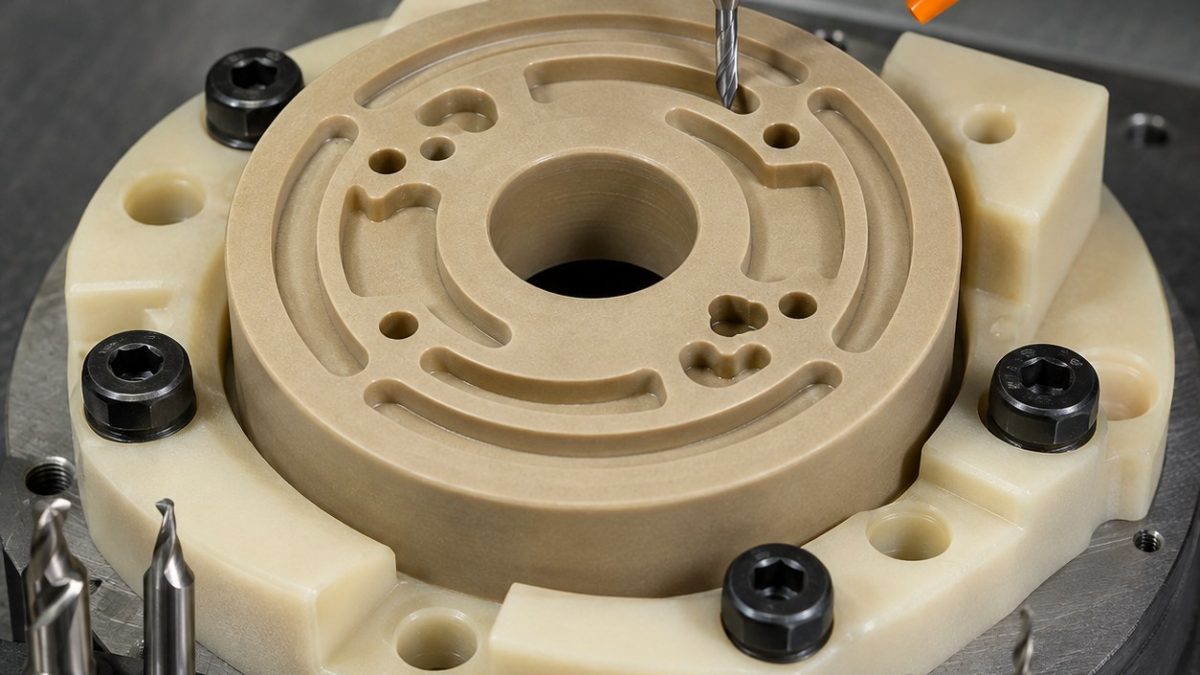
English: PEEK-GF30 Rotary Valve Rotor Tooling for Seal Lands and Metering Slots
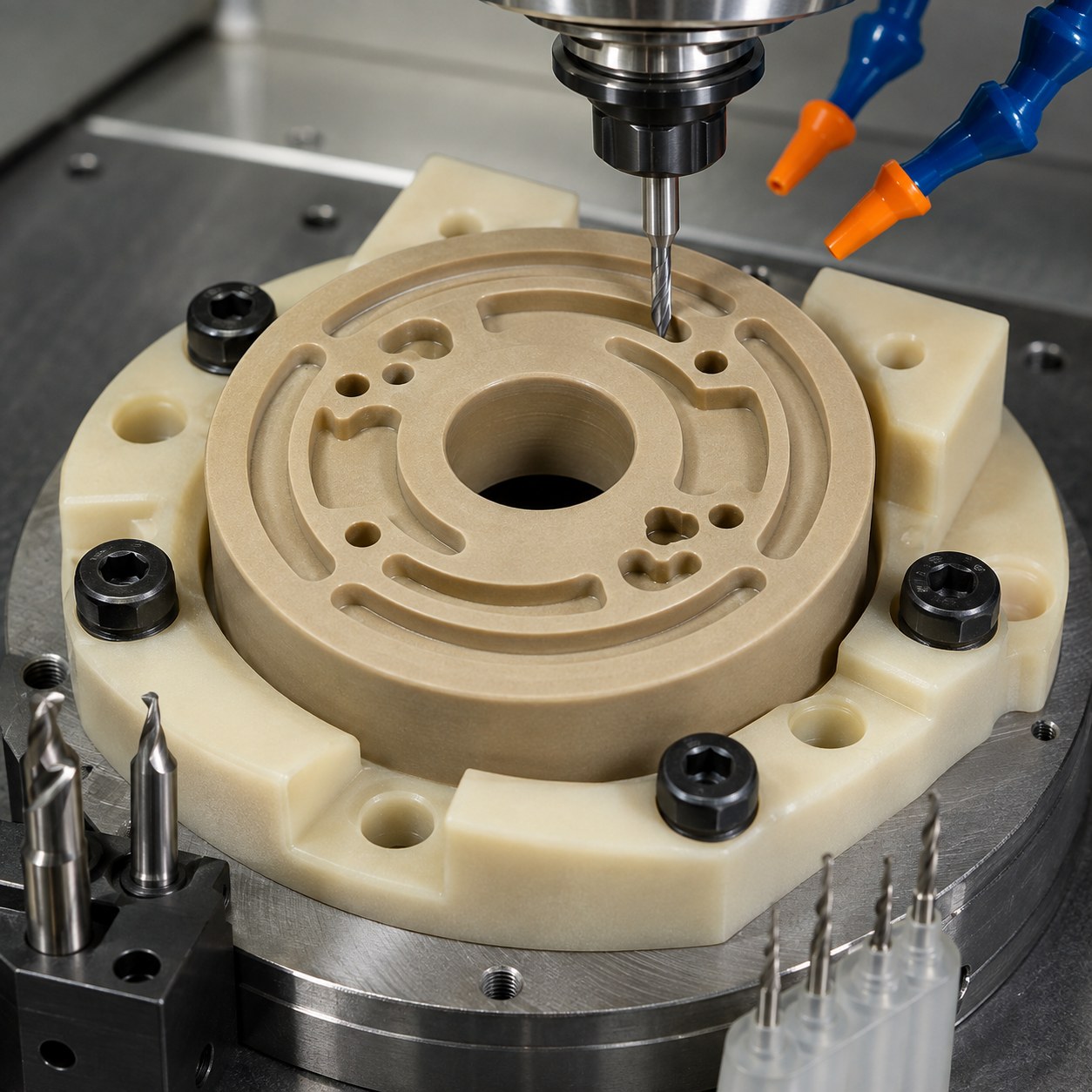
The useful search intent here is practical PEEK-GF30 tool selection for a valve rotor where seal lands must stay flat and glass fibers cannot bridge a metering slot. The drawing is interpreted by function: sealing, dosing, port transfer and free-state roundness.
Drawing zones and tool decisions
| Feature on the drawing | Selected tool package | Reason and rejected alternative |
|---|---|---|
| Hub bore | Sharp single-flute boring tool with polished carbide insert | Keeps roundness under low clamp force; interpolation with a dull tool would heat the polymer. |
| Radial seal lands | 6 mm single-flute polished carbide, uncoated, air assist | Maintains flat sealing bands without smearing glass-filled PEEK. |
| Curved metering slots | 2.5 mm two-flute polished necked end mill, high-accuracy collet | Reaches curved slots while keeping chip space and low side force. |
| Cross ports | Carbide micro drill over sacrificial PEEK support | Prevents exit fiber breakout into the metering slot. |
| Edge break | Single-flute 90-degree chamfer tool plus soft brushing | Removes fibers without rounding the seal land. |
Machining sequence and fixture logic
Use a soft nest that supports the ring and hub separately. Bore the hub first, mill seal lands with light axial stock, open metering slots in balanced angular order, then drill cross ports into backed cavities. Edge break follows inspection, not before, so a burr is not hidden by over-rounding.
Material-specific chip, burr and tool-life controls
Glass-filled PEEK cuts hotter than unfilled PEEK and leaves springy fibers. Use sharp polished tools, air assist and short engagement. Stop when fiber whiskers lengthen or seal-land gloss changes; do not solve fuzz by pressing a dull chamfer tool harder.
Inspection plan tied to the tolerance stack
Inspect hub roundness, seal-land flatness, metering-slot width, cross-port openness and free-state rocking. A low-pressure air-flow check catches fibers that a CMM cannot see.
FAQ
Why use uncoated polished carbide on PEEK-GF30?
A sharp low-friction edge cuts fibers with less heat than a thick coated edge.
Can the seal land be hand deburred?
Only outside the sealing track; hand work on the land risks leakage.
Why drill ports after slots?
The slot geometry gives a supported breakout target and makes fiber inspection easier.