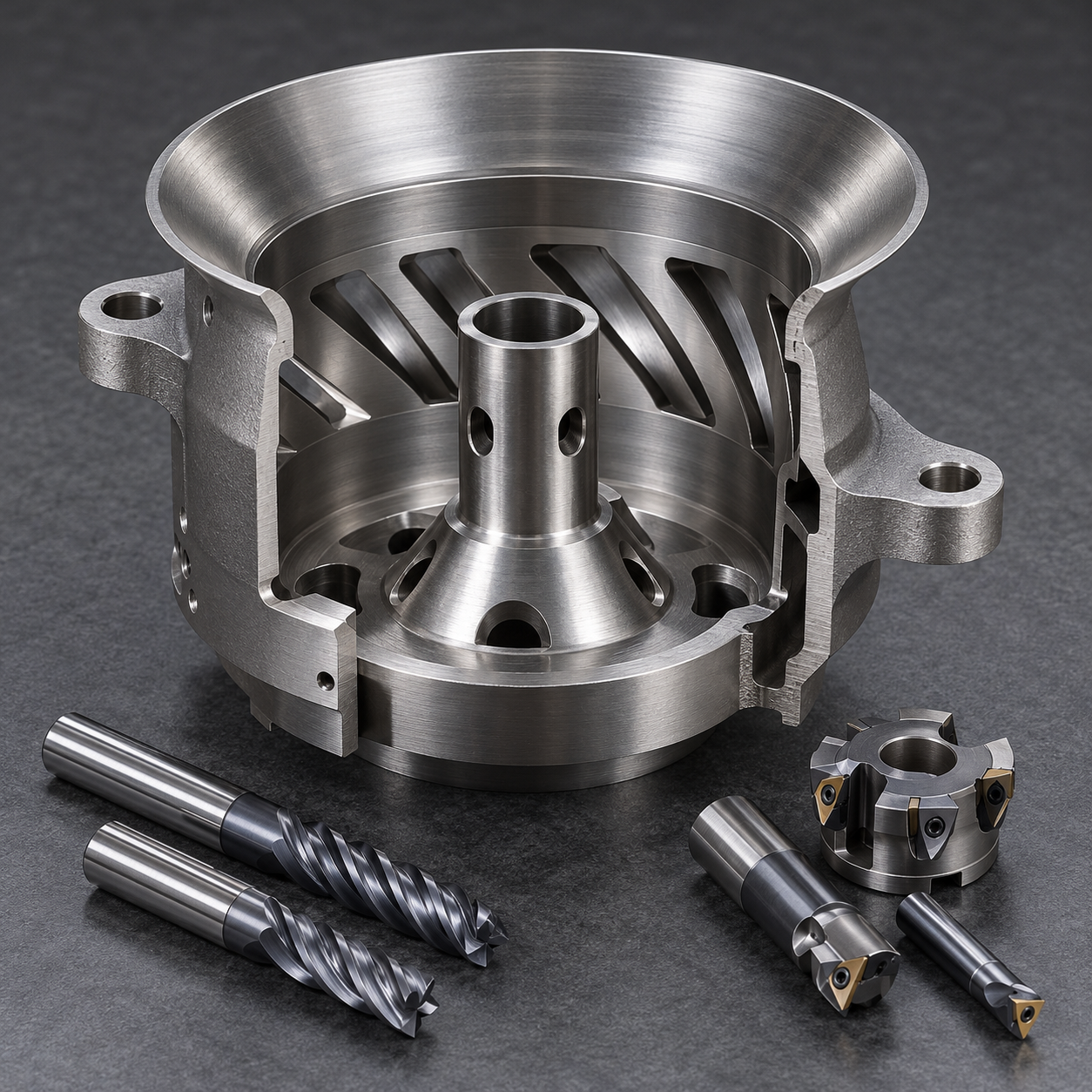
English: Hastelloy X Swirl Cup Tooling for Angled Vane Windows and a Thin Exit Lip
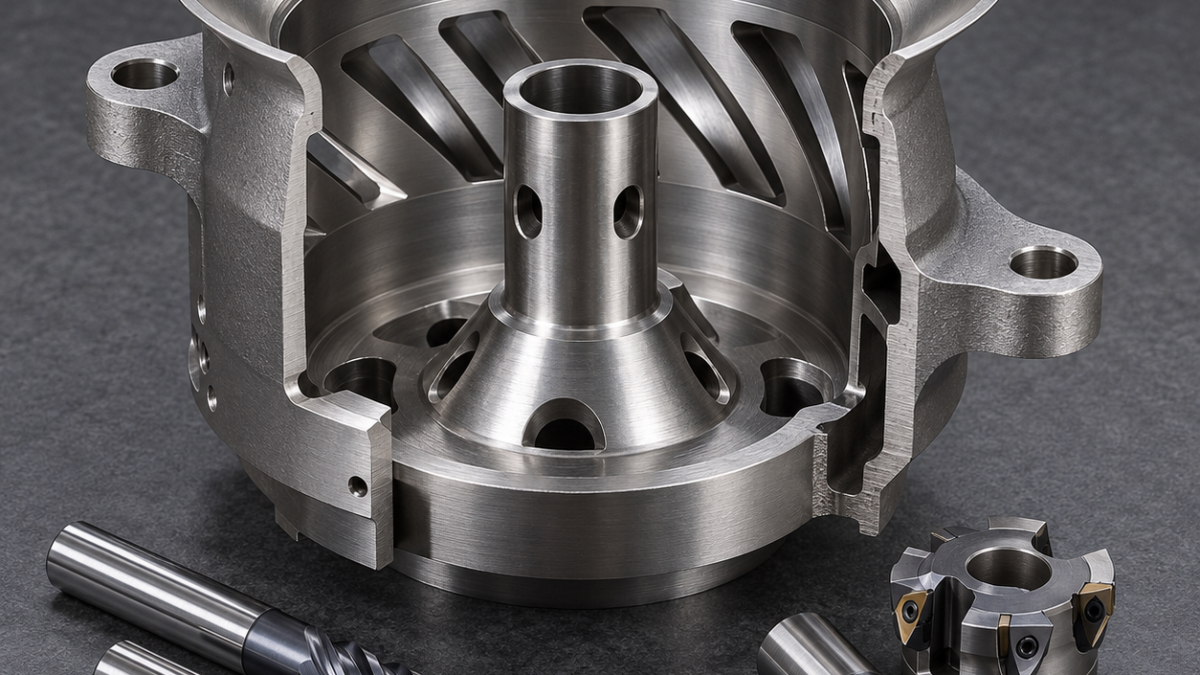
The long-tail problem is how to machine a Hastelloy X swirl cup without changing the vane-window throat or rolling the thin exit lip. The drawing makes airflow geometry depend on window angle, minimum ligament and bore-to-lip concentricity. Tool choice therefore follows access direction and edge condition, not merely pocket width.
Protect the airflow throat before chasing surface finish
Turn the mounting pilot, fuel bore and reference face in one chucking with a sharp PVD-coated carbide insert. Leave the flare thick. On a five-axis fixture located from the pilot, rough each window with a 6 mm four-flute AlTiN radius end mill in short constant-engagement arcs, then semifinish the throat with a 4 mm tapered neck tool. A long cylindrical cutter is rejected because its holder collides before the cutting edge reaches the exit wall.
Feature-to-tool map for the swirl cup
| Drawing feature | Carbide tool and holder | Selection logic / rejected alternative |
|---|---|---|
| Pilot, face and fuel bore | Sharp PVD carbide turning insert; damped 8 mm boring bar | Keeps the rotational references together; a reamer cannot correct bore runout. |
| Window roughing | 6 mm, 4-flute AlTiN radius end mill in hydraulic holder | Constant engagement controls heat; a high-flute cutter packs nickel-alloy chips. |
| Angled throat semifinish | 4 mm tapered-neck carbide end mill, 3 flutes | Adds holder clearance without excessive flex; a straight long-reach tool collides. |
| Vane-face finish | 3 mm, 5-flute variable-helix carbide tool in shrink fit | Stable swarf contact limits waviness; a ball mill changes the throat at tool-center contact. |
| Thin exit lip | Sharp positive carbide insert, 0.2 mm radius, internal support ring | Low radial force protects the flare; a wide wiper can fold the edge. |
Open the vane windows while the rim is supported
Alternate opposing windows so heat and cutting force do not accumulate on one sector. Finish the vane faces with a 3 mm five-flute variable-helix end mill held in a shrink-fit holder, using a swarf path that keeps the side edge engaged. The exit lip is turned last with a sharp 0.2 mm nose-radius insert and a sacrificial internal support ring. A broad wiper or abrasive hand blending can roll the lip and change its effective area.
Separate heat control from burr control
Probe the pilot and bore before unclamping, then scan window entry and exit curves on a rotary CMM routine. Optical edge measurement records lip thickness at each vane pitch; a pin or replica checks the minimum throat. Tool life is ended by corner notch growth, spindle-load drift or a measurable throat shift, even when the cutter still looks usable.
Related tooling comparisons: combustor igniter-boss tooling; turbine seal-segment tooling.
Swirl-cup tooling FAQ
Why not wire-EDM the windows? Access, recast qualification and a closed three-dimensional exit make it a different process. Why is the lip left thick? It stiffens the window ring during interrupted milling. Which holder is preferred? A short shrink-fit holder for vane finishing, with collision clearance proven in simulation.
For alloy-first comparison across pockets, holes, seats, grooves and thin sections, use the nickel-alloy CNC tooling decision hub.