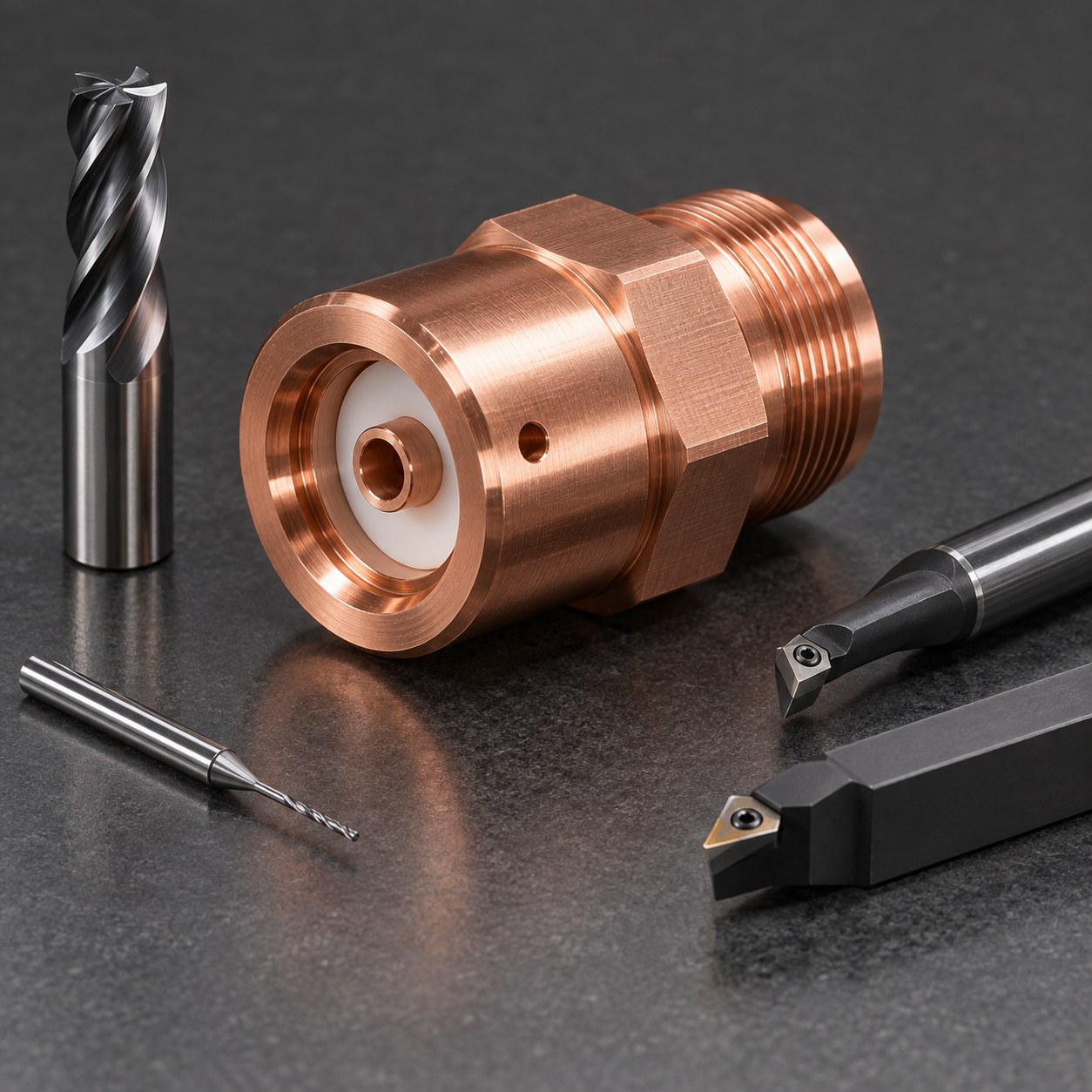
English: C14500 RF Feedthrough Tooling for Counterbore and Radial Vent
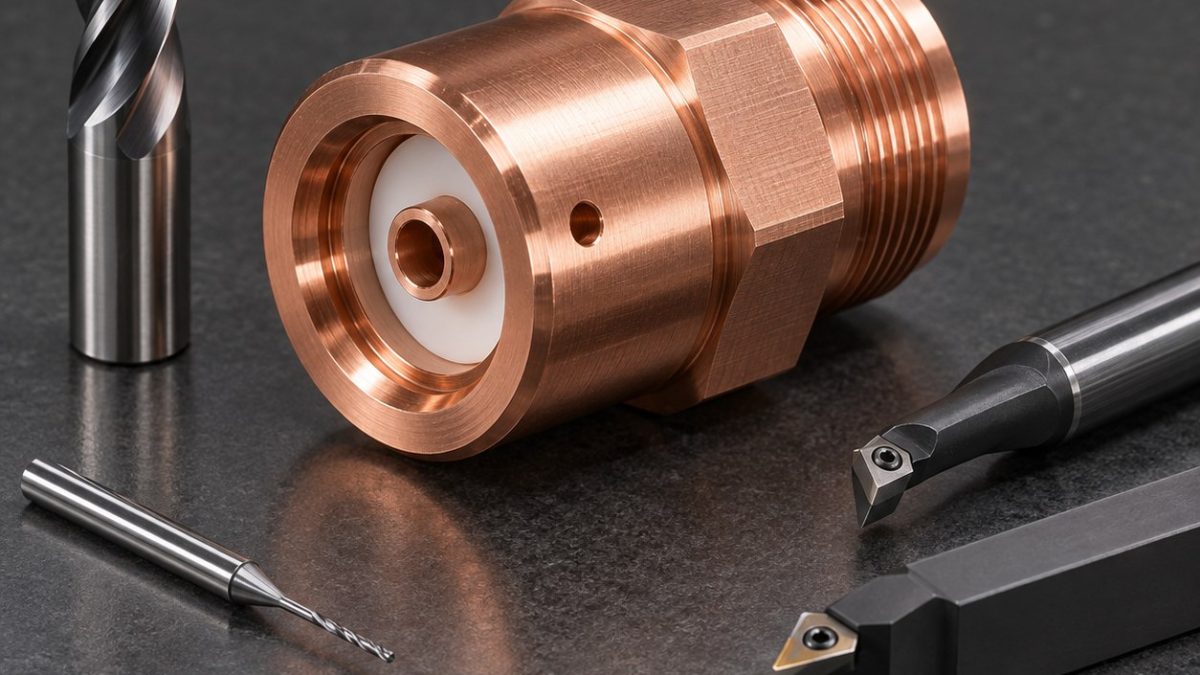
This case addresses tool selection when a thin annular RF reference land must remain concentric with a dielectric counterbore after a radial vent breaks through. The drawing is dimensioned from the connector face and pilot bore; wrench flats are tertiary handling features. Dimensions are illustrative and do not claim electrical qualification.
Choose tools before breaking the bore wall
| Drawing feature | Carbide tool and holder | Why selected / alternative rejected |
|---|---|---|
| Pilot and dielectric counterbore | Carbide drill followed by 6 mm polished single-edge boring tool in precision collet | A single-edge tool controls size with clear chip space; a multi-flute reamer can bell-mouth soft copper. |
| Thin annular RF land | Sharp uncoated micrograin carbide grooving insert, 0.05 mm hone, rigid Swiss-style holder | Small edge preparation limits push-off; a heavy honed insert smears the land. |
| Fine external mounting thread | Ground full-profile uncoated carbide laydown insert with minimum overhang | Full profile controls crest burr; a partial-profile insert leaves extra crest cleanup. |
| Radial vent hole | 0.8 mm polished two-flute carbide drill, through-spindle oil mist where approved, ER precision collet | Short pecks evacuate ductile chips; HSS wanders and leaves a hanging exit burr. |
| Wrench flats and edge relief | 5 mm 3-flute polished ZrN carbide end mill plus single-flute chamfer mill | Three flutes balance evacuation and finish; abrasive hand filing can contaminate the RF land. |
Control copper smearing and thread burrs
Turn the face, pilot, counterbore and RF land from bar in one collet grip. Cut the thread with a spring-free final pass, transfer to shaped soft jaws on the thread relief, then mill flats. Drill the radial vent before the final counterbore skim so the exit burr is removed by a controlled internal pass.
Sequence the vent around the RF land
C14500 breaks chips better than pure copper but still welds to a dull edge. Keep polished flutes clean, limit runout on the 0.8 mm drill and reject the tool when the counterbore becomes cloudy or the vent produces a copper whisker. Excessive coolant pressure can bend the micro drill.
Inspect concentricity without marking copper
Use polymer-tipped contacts to measure face-to-land distance and counterbore diameter, then verify pilot-to-thread runout between soft centers. Inspect the vent intersection at magnification and confirm no raised edge crosses the annular land. Electrical return loss and dielectric assembly remain separate tests.
Practical tooling FAQ
Why drill the radial vent before the last bore skim?
The final internal pass removes the exit burr without touching the thin RF land by hand.
Why avoid a spring pass on the copper thread?
Rubbing can smear the crest and change pitch-diameter readings without removing useful stock.
PEEK-CF30 Wafer Transfer Fork CNC Tool Selection for Thin Tines and Vacuum Grooves · S32760 Super Duplex Sensor Collar CNC Tool Selection for Seal Groove and Radial Keyway