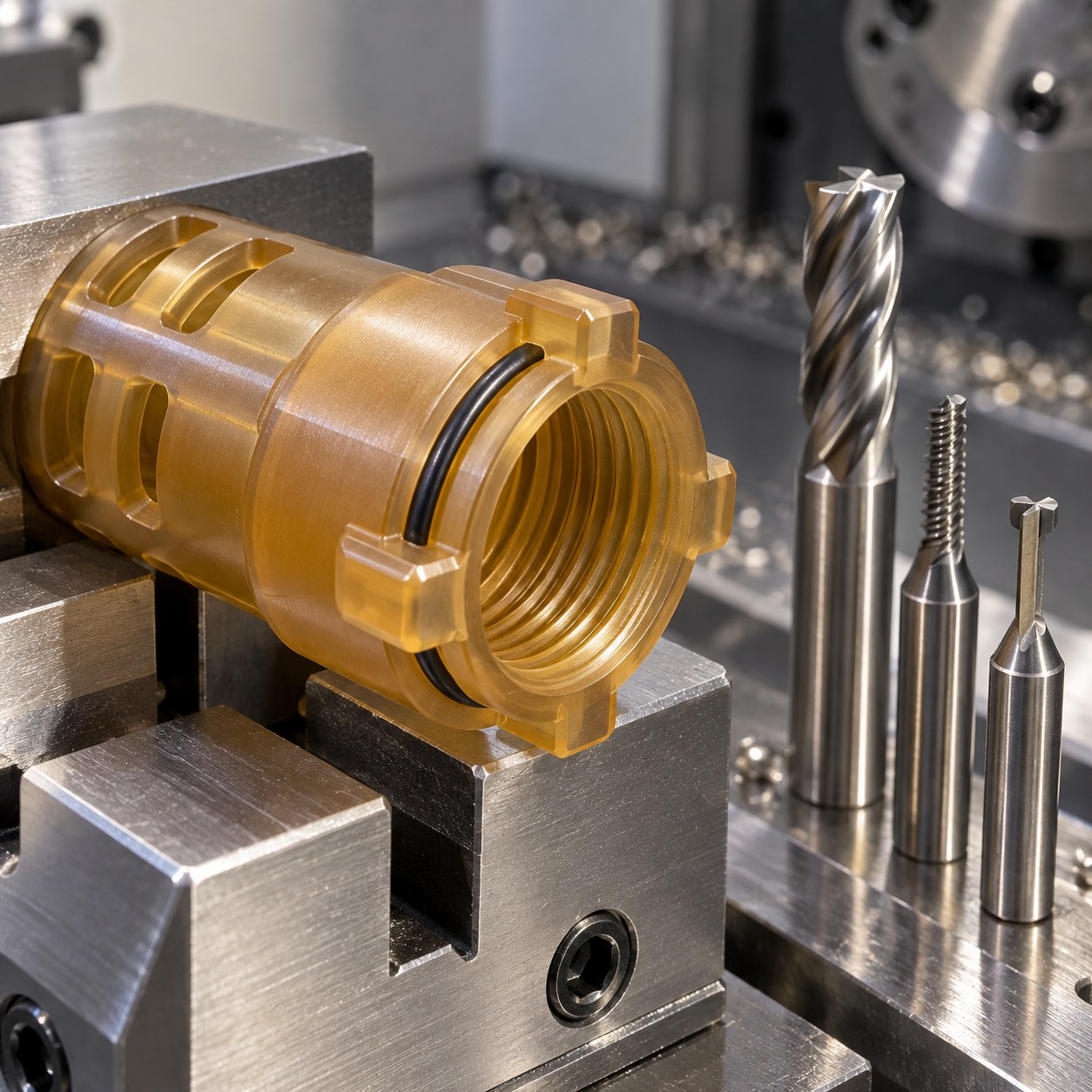
English: PEI Connector Backshell Tooling for Bayonet Lugs and Cable Thread
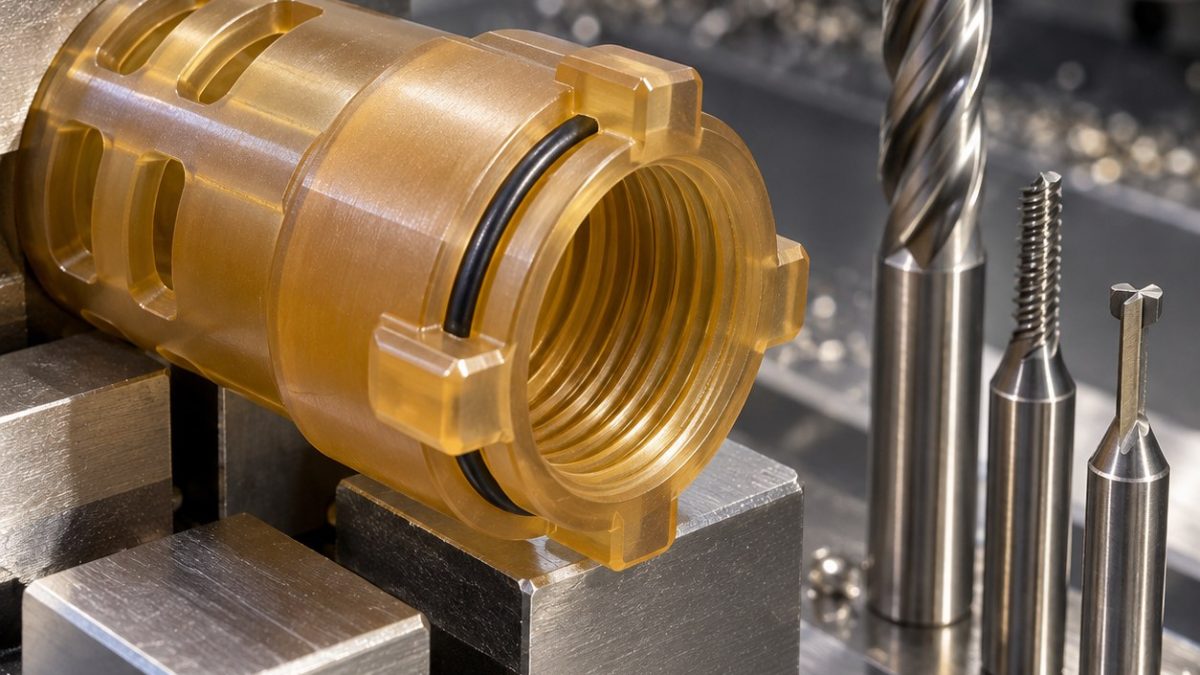
For a hypothetical PEI Ultem 1000 avionics connector backshell, the bayonet lugs and cable-gland thread determine the cutter set. The drawing uses three clocked lugs, a 1.6 mm wall beside the thread, a narrow O-ring recess and four strain-relief slots. Illustrative acceptance targets are 0.06 mm lug-position error from datum A and a specified thread gauge fit. Sharp polished tools keep the polymer from heating and springing away from the cutter.
Bayonet and cable features mapped to tools
| Drawing callout | sharp carbide selection | why the substitute fails |
|---|---|---|
| Cylindrical shell and inner bore | 8 mm two-flute polished uncoated carbide end mill, high positive rake, short shrink holder | Rough in shallow radial steps; a coated steel rougher promotes heat and fuzzy edges. |
| Three bayonet lugs | 3 mm two-flute polished carbide neck-relieved end mill, 10 mm reach | Semi-finish lug roots before a light climb finish; a long 1 mm cutter flexes needlessly. |
| Cable-gland internal thread | Single-profile 2 mm uncoated polished carbide thread mill in rigid collet | Helical interpolation allows fit adjustment and avoids the torque of a tap in a thin wall. |
| O-ring recess | 1.2 mm polished carbide T-slot/groove cutter with limited neck reach | One controlled groove avoids rubbing; a hand scraper risks depth error. |
| Strain-relief slots and chamfer | 1.5 mm single-flute polished carbide upcut, then 45° single-flute chamfer | Open chip space limits melted whiskers; broad multi-flute tools trap warm chips. |
Hold the shell without flattening it
Turn or mill a sacrificial gripping collar first. A split polymer sleeve in soft jaws supports the bore while the outer lugs are rough and semi-finished; transfer to a close-fitting internal mandrel for their final clocking. Keep the thread wall supported during milling, then cut the O-ring recess and relief slots only after the major bore is stable. Make the last lug pass from the same rotary datum A used for inspection.
Control heat before chasing fit
Use dry filtered air and frequent chip clearing; confirm any coolant and cleaning solvent against the specified PEI grade and service requirement. Maintain a chip load that cuts rather than polishes. Stringy burrs on the lug roots or a glazed thread flank indicate edge wear or chip recutting. Stop and inspect runout before reducing feed, since rubbing can make a smaller-looking feature spring back after unclamping.
Gauge the assembly functions
Measure lug clocking and thickness by vision after the sleeve is removed, check the thread with the specified mating gauge, and probe the O-ring recess width and depth without deforming it. Inspect the slots for white stress marks and residual whiskers under magnification. Record bore roundness and wall thickness in the free state, and validate actual mating rotation with a representative counterpart rather than judging the lugs by appearance alone.
Tooling questions
Why mill the internal thread instead of tapping?
The thread mill lowers torque in a thin polymer wall and permits controlled fit correction.
Can flood coolant improve the finish?
Use only a fluid approved for the specific PEI grade and downstream service; chip control remains essential.
What is the first sign of a worn lug cutter?
A fuzzy root edge or changing lug thickness after release.
Related drawing-based tooling: Tungsten Heavy Alloy Collimator Insert CNC Tool Selection for Stepped Slit Aperture and Dovetail Rail; Kovar Hermetic Connector Header Plate CNC Tool Selection for Glass Seal Bores and Pin Hole Array.