Related drawing references: ETFE Diaphragm Support CNC Tool Selection for Spiral Flexure and Raised Sealing Bead and Rene 41 Turbine Seal Segment CNC Tool Selection for Honeycomb Pocket and Feather Edges.
English: 410 Stainless Pump Impeller Tooling for Thin Blades and Balance Pads
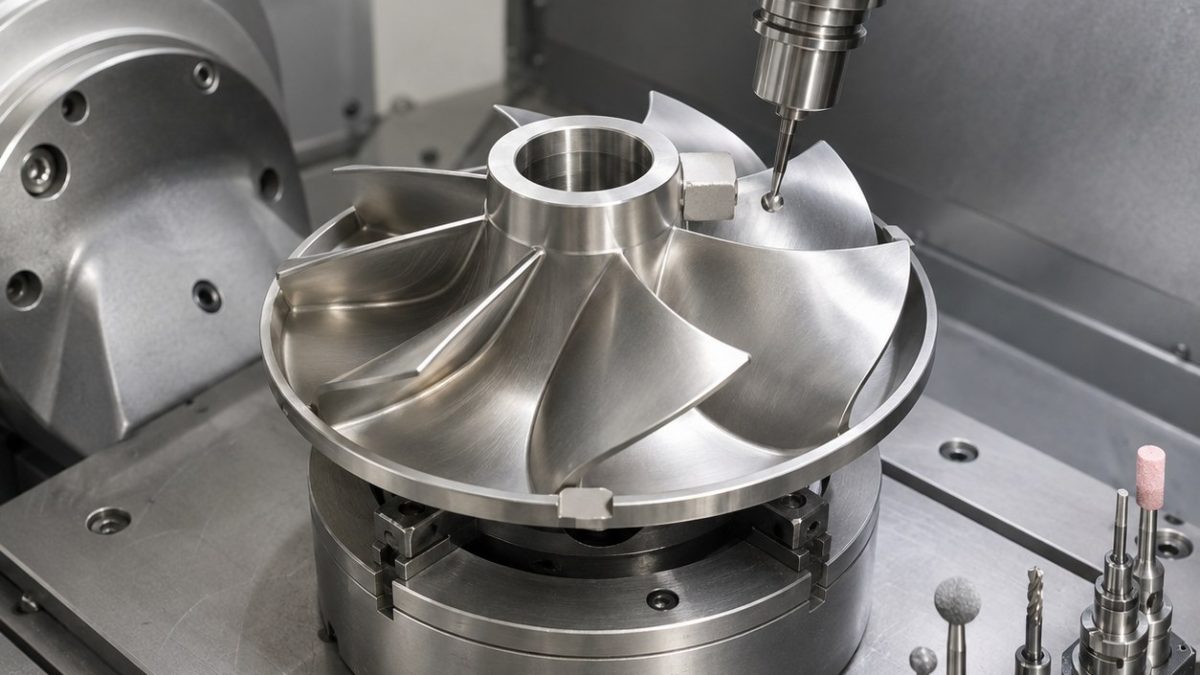
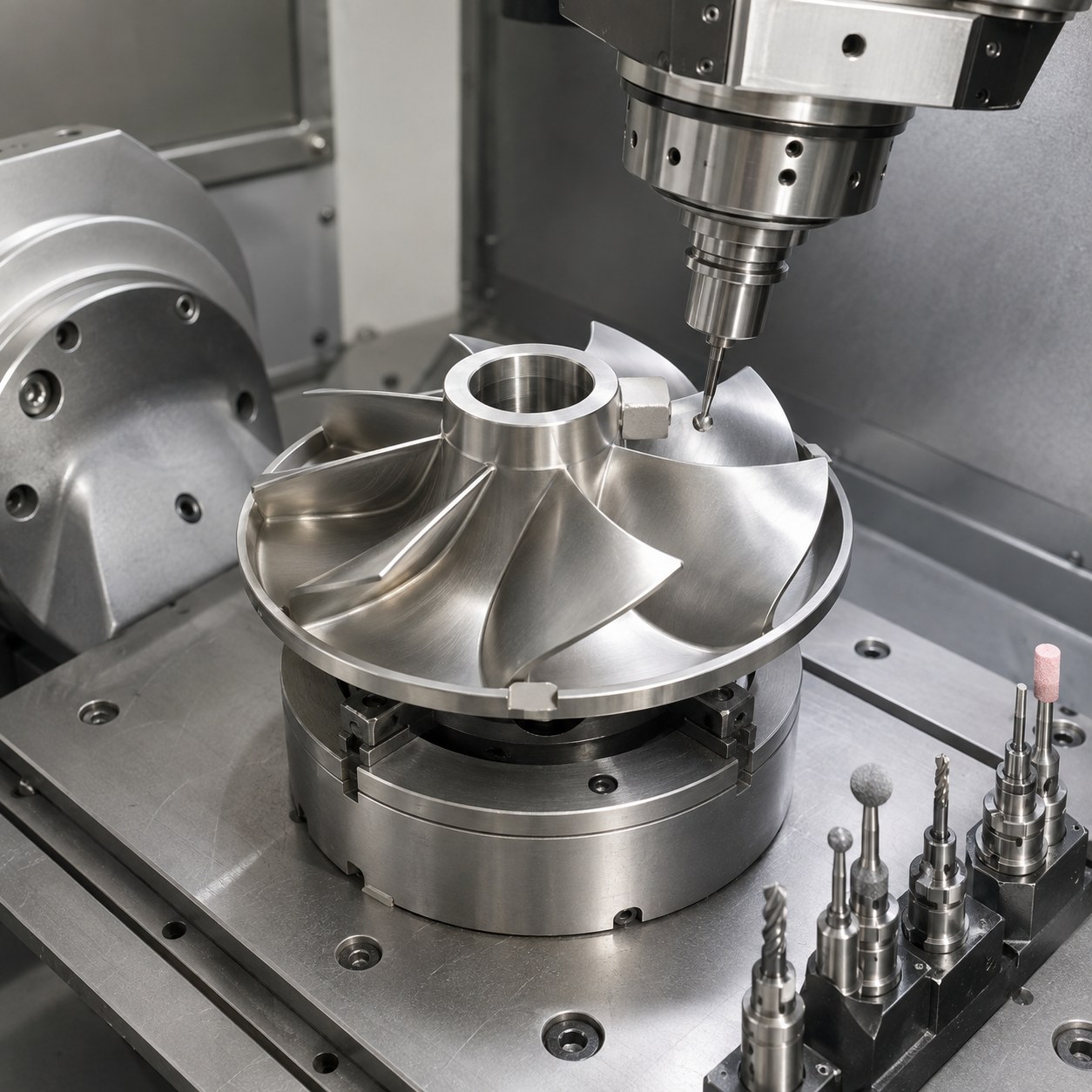
This impeller case answers a five-axis tooling question: how to finish thin 410 stainless blades while keeping the hub bore, shroud lip and balance pads tied to one measurable datum chain. Cutter pressure, holder reach and hidden burr access decide the route.
Feature-to-tool selection from the drawing
| Drawing feature | Selected tool and holder | Tooling reason and rejected option |
|---|---|---|
| Hub bore and datum | Boring head with TiAlN carbide insert and hydraulic holder | Locks the rotary axis before blade finishing; interpolation alone risks lobing. |
| Blade roughing | 8 mm high-helix 5-flute carbide, variable pitch, trochoidal entry | Controls heat and chatter while leaving even blade stock. |
| Blade surface finish | 10 mm barrel cutter plus 4 mm ball mill for root access | Uses the barrel cutter where possible and reserves the ball tool for tight radii. |
| Thin shroud lip | 3 mm corner-radius carbide, alternating light passes, long-reach shrink holder | Limits radial pull; a heavy slotting pass would spring the lip. |
| Balance pads and deburr | Small carbide end mill plus lollipop deburr tool | Machines removable pads and breaks hidden blade exits without filing. |
Process order, roughing and finishing
Rough the hub and back face first, finish the bore, then use five-axis indexed roughing between blades with equal stock left on both sides. Barrel finishing follows the blade mid-span, ball finishing cleans root radii, and balance pads remain oversize until after dimensional inspection.
Material risk, chips and tool life
410 stainless can chatter and locally harden when the blade vibrates. Maintain constant chip load, avoid dwell at the shroud lip, and replace finish tools when load trend changes before a burr appears. Air blast plus directed coolant keeps chips out of blade roots.
Tolerance, finish and inspection plan
CMM verifies bore axis, blade thickness at three spans, shroud lip runout and balance-pad stock. A borescope checks hidden exits, while a light spin check confirms no blade rub before dynamic balancing.
FAQ for this tooling case
Why combine barrel and ball tools?
The barrel cutter shortens open blade finishing, while the ball mill reaches tight root radii without forcing a long small tool everywhere.
How is thin-blade chatter controlled?
By equal stock, constant chip load, alternating passes and holder reach matched to each blade zone.
When are balance pads finished?
After bore and blade inspection, so material remains available for final balancing correction.