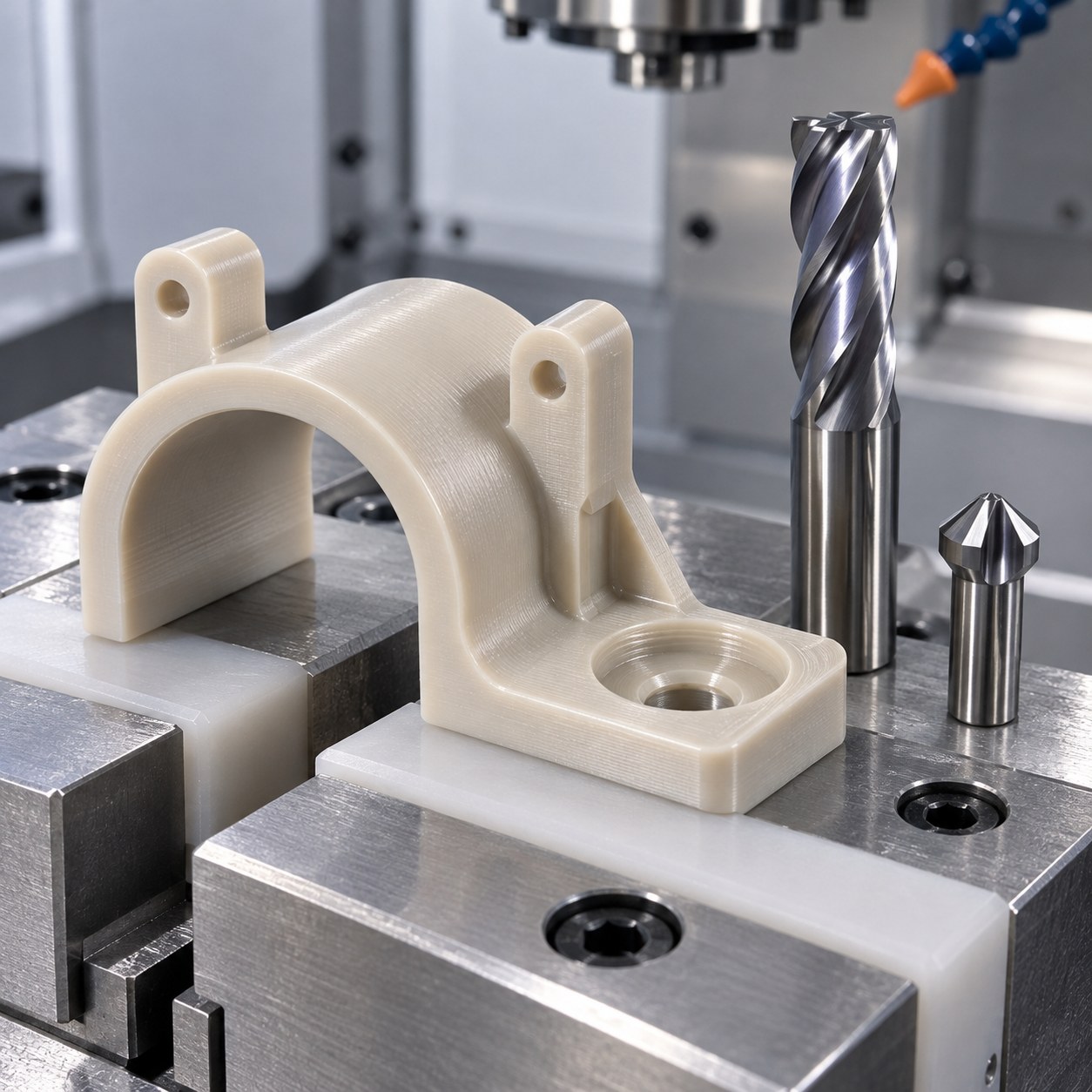
English: PEKK Harness Clamp Tooling for Curved Saddle and Retention Ears
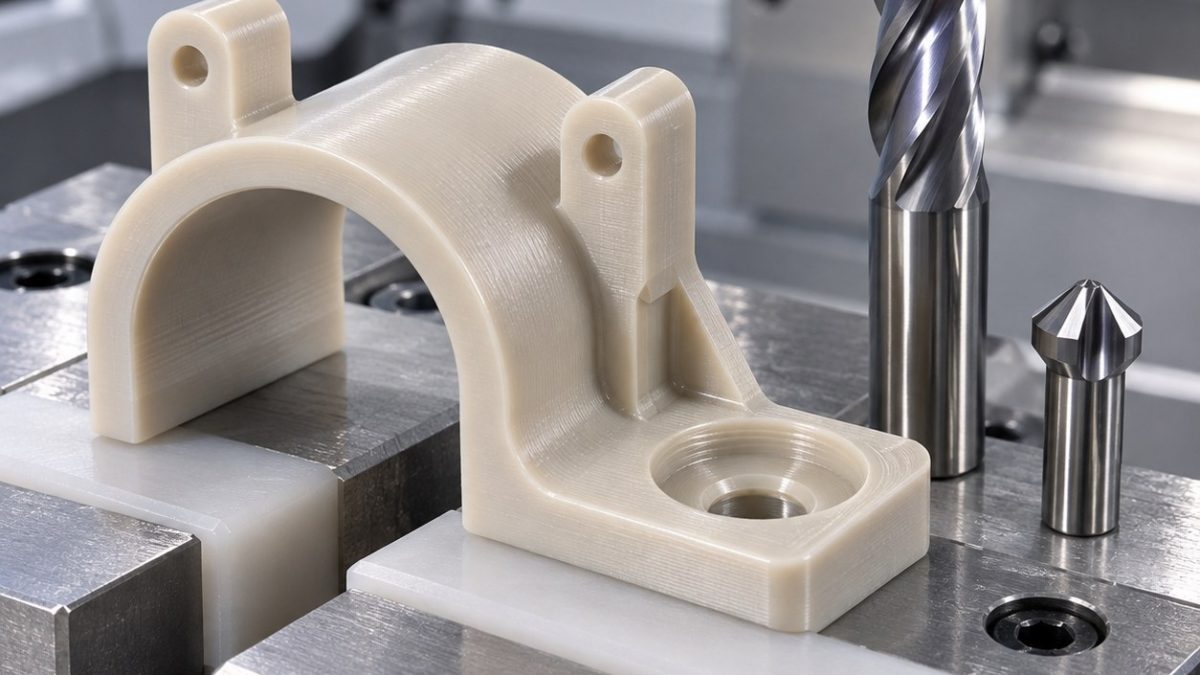
For this hypothetical PEKK harness clamp, the cable saddle is the functional surface and the retention ears are the fragile features. The drawing is read from the saddle radius and its relation to the fastener seat; the outside silhouette comes later. Example dimensions are for machining discussion only.
Forming the cable seat first
Hold the stock on a broad vacuum plate or soft nest and finish the saddle before separating the ears. Keep thin bridges at the ear tips during pocket work; only after the fastener seat and major contour are stable should the bridges be removed with a light climb pass.
Feature-to-tool choices
| Feature | Tool | Decision |
|---|---|---|
| Curved saddle | 6 mm 2-flute polished uncoated carbide ball mill, short collet | Light 3D finish preserves radius; a coated rougher leaves a hazy contact surface. |
| Retention ears | 2 mm single-flute polished carbide, 8 mm reach | Rough around each ear with a support web; long multi-flute tools heat the edge. |
| Anti-rotation pocket | 3 mm 2-flute polished carbide end mill, high rake | Helical entry avoids pushing a thin wall; plunge milling can whiten it. |
| Fastener seat | Carbide spot drill then short 90° chamfer cutter | Seat is cut before final ear release; hand countersink rounds the datum. |
| Contour edge | PCD or polished carbide compression cutter | Choose PCD only where volume justifies it; an abrasive wheel raises heat. |
Heat and polymer burr control
PEKK rewards sharp polished edges and real chip formation. Clear warm chips before they smear the saddle, and use only a coolant or cleaning method approved for the specified grade and service. Whitening, a stringy burr or a changing saddle radius points to heat or a worn edge.
Free-state assembly checks
Check saddle radius with an appropriate contour method, ear thickness and position by vision, and fastener-seat geometry after release. Use a representative nonfunctional cable dummy for retention fit; it does not replace any aircraft qualification.
Practical tooling FAQ
Why keep bridges at the ears?
They prevent a thin polymer ear from moving during pocket work.
Does a smooth saddle prove service performance?
No; it only verifies machined geometry.
Tantalum Sputtering Target Clamp Ring CNC Tool Selection for Stepped Seat and Relief Slots · PEI Ultem Connector Backshell CNC Tool Selection for Bayonet Lugs and Cable Thread