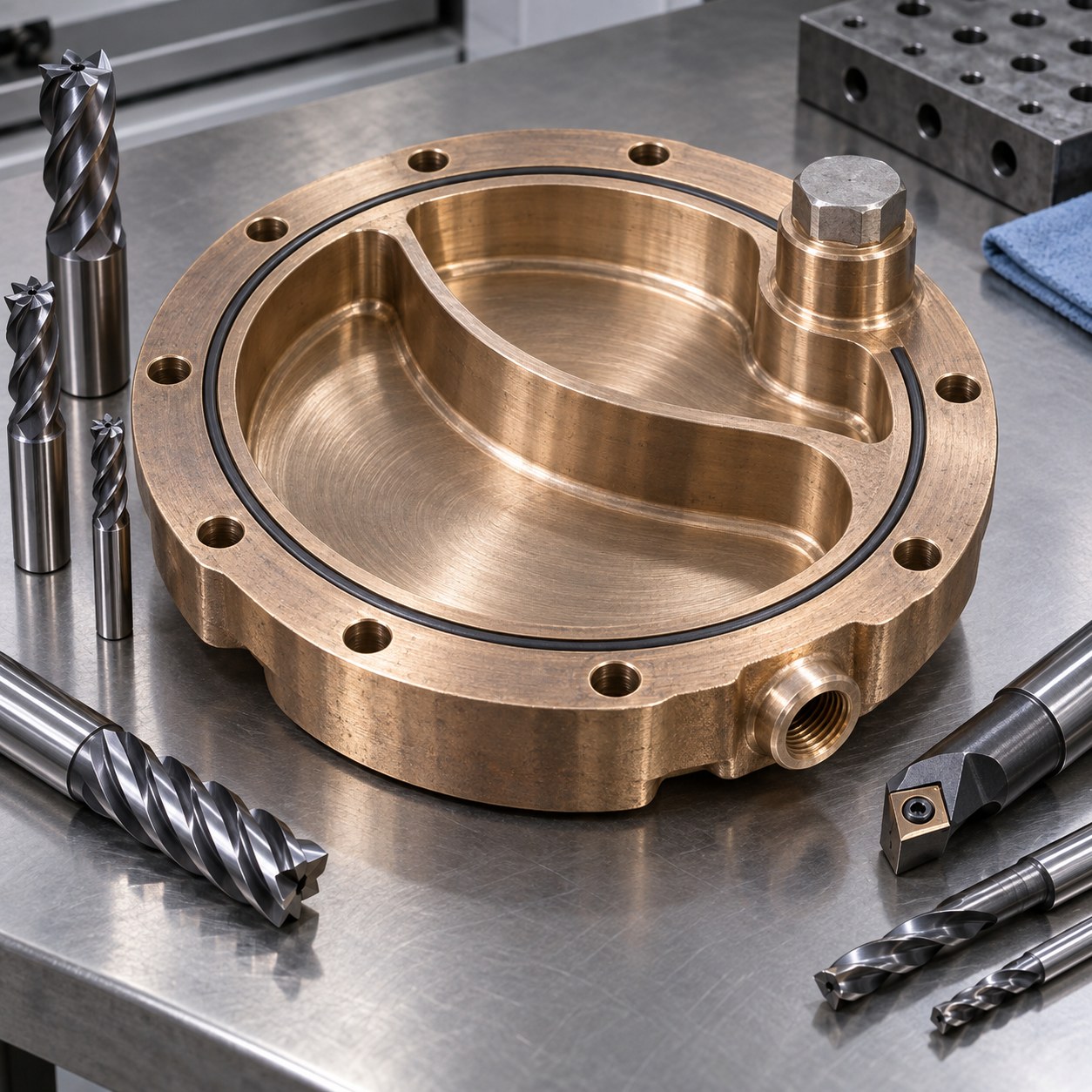
English: C71500 Channel Cover Tooling for Divider Groove and Anode Boss
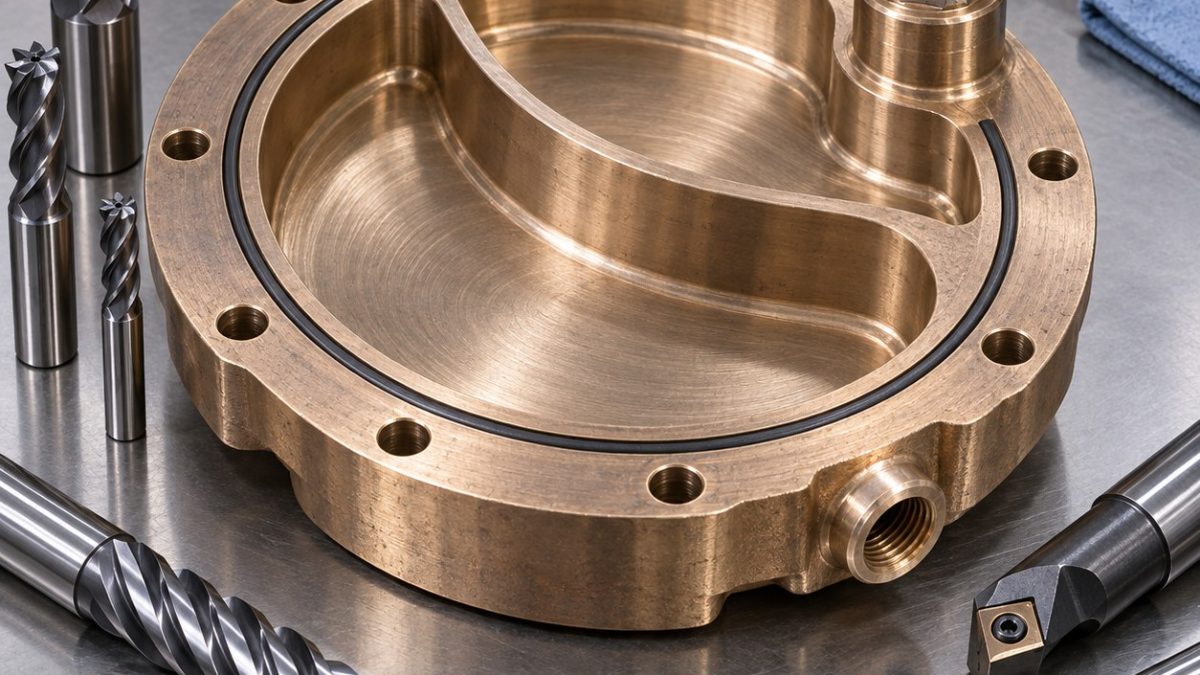
The drawing question is how to finish a curved divider and narrow gasket tongue without letting the offset anode boss pull the broad cover out of flat. The hypothetical datum chain starts at the mounting face, uses the bolt circle for clocking and locates the drain from the divider centerline. The cast rim is stock, not a sealing datum.
Tool map from face to seawater cavity
| Drawing feature | Carbide tool and holder | Why selected / alternative rejected |
|---|---|---|
| Mounting face and cavity | 16 mm 3-flute polished ZrN carbide end mill in hydraulic holder | Positive helix clears ductile chips; a steel high-feed cutter smears the surface. |
| Curved divider groove | 8 mm 3-flute polished uncoated carbide end mill, variable helix, shrink holder | Constant-engagement passes protect the thin divider; full-width slotting pushes it sideways. |
| Narrow gasket tongue | 4 mm 2-flute polished carbide radius mill with 8 mm reach | A light radial finish preserves the crest; a broad form tool loads both walls. |
| Sacrificial-anode boss | Short fine boring bar with polished positive insert, then carbide thread mill | Boring establishes axis before thread milling; a tap can seize and twist the offset boss. |
| Drain port and bolt circle | Carbide spot drill and through-coolant drills plus single-flute chamfer mill | Spotting on the curved pad prevents walk; hand deburring can roll metal onto the gasket land. |
Balance the offset boss and curved divider
Face the broad mounting surface on a vacuum-assisted nest with mechanical stops, then rough the two chambers in alternating depth bands. Leave the divider and gasket tongue oversize while boring the anode boss. Semifinish the curved groove, release the cover for stress check, reclamp on datum pads and finish the tongue with one continuous contour. Drill the drain and bolt pattern last from the same clock datum.
Prevent copper-nickel adhesion
C71500 can form a built-up edge when polished flutes become dull. Keep chip load positive, direct coolant along the curved groove and replace the finishing tool if the floor turns glossy or a copper lip follows the cutter. Do not compensate cover bow with Z offsets; correct support and removal balance first.
Inspect flatness and gasket continuity
Measure mounting-face flatness in the released state, then map gasket-tongue height around the full circumference. Probe divider position relative to the bolt clock, inspect the anode thread and drain intersection, and record cavity texture along flow direction. Pressure and corrosion qualification remain separate tests.
Practical tooling FAQ
Why release the cover before final tongue milling?
Broad asymmetric stock removal can move the face; a release check prevents machining the final seal onto a clamped shape.
Why thread-mill the anode boss?
It limits torque on the offset boss and permits diameter correction without forcing a tap through adhesive copper-nickel.
bronze carrier bore and slot tooling · pump cover seal-groove strategy