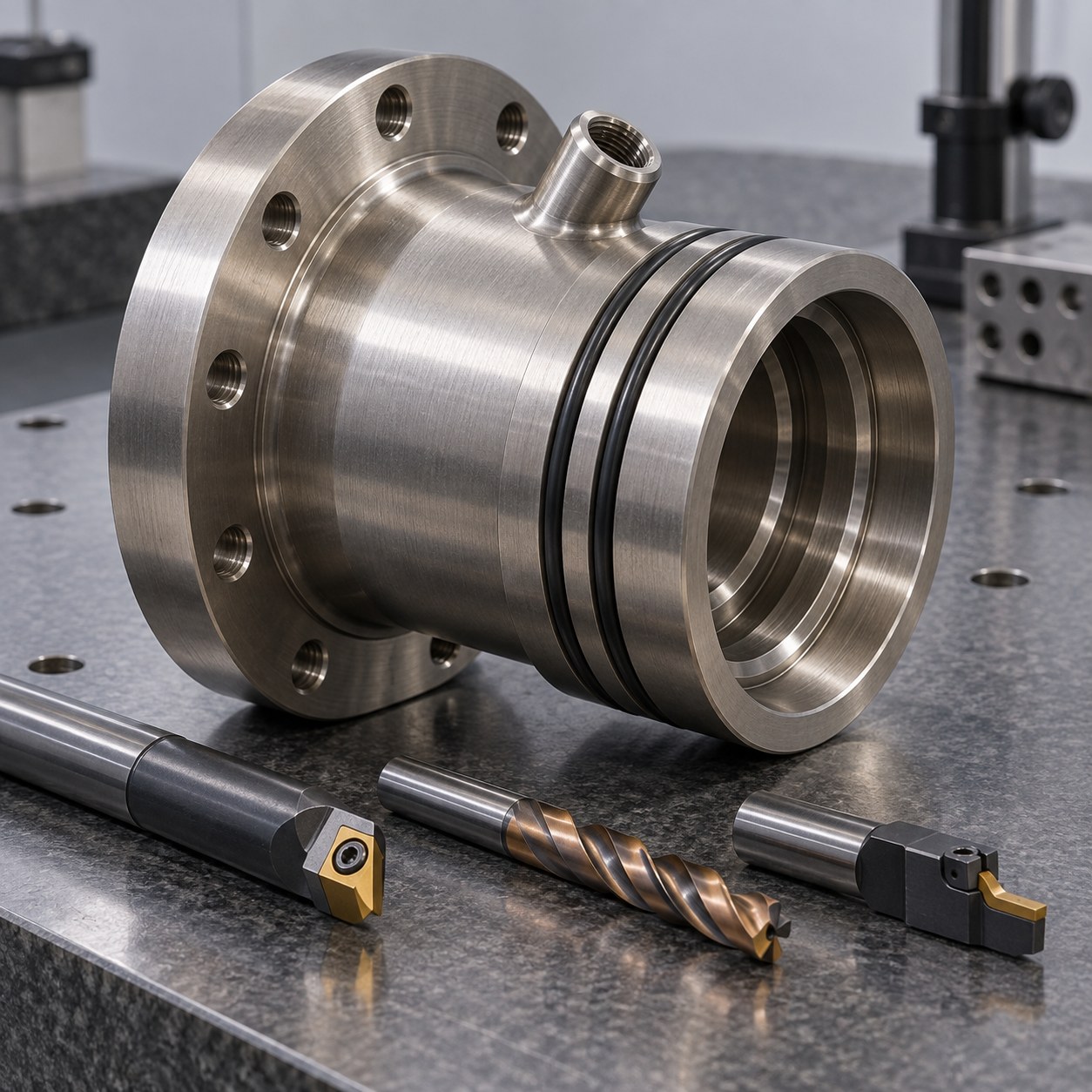
English: Monel 400 Cable Penetrator Tooling for Seal Grooves and Leak Port
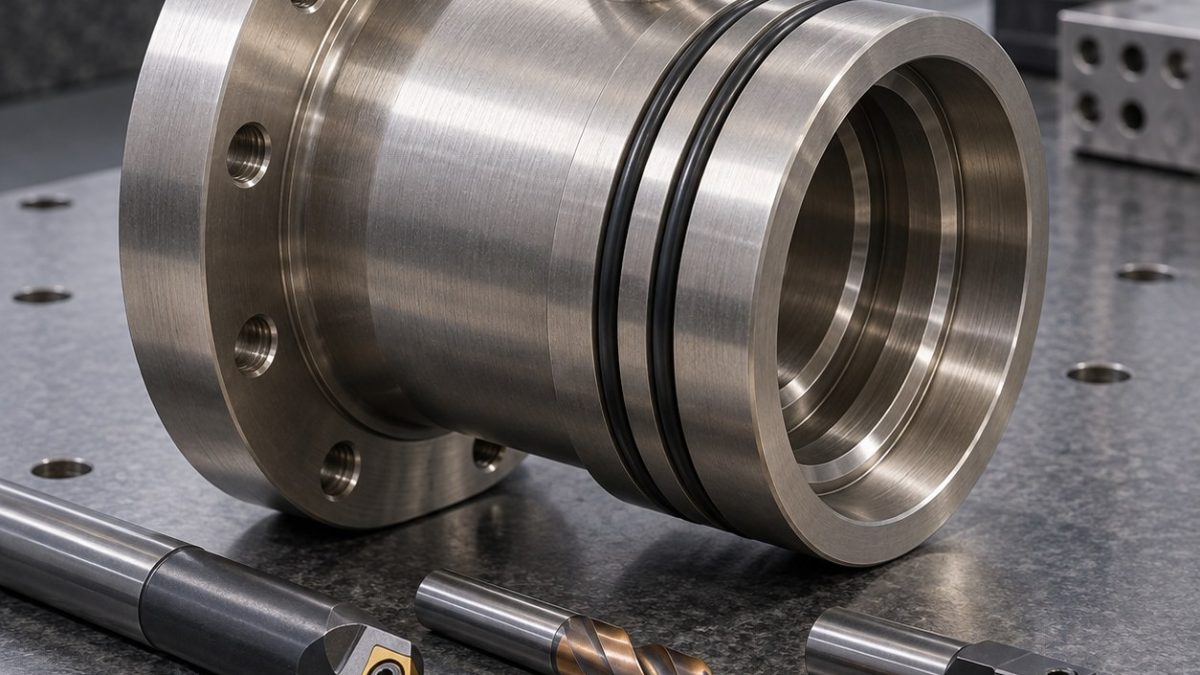
For a Monel 400 cable penetrator, the key tooling question is how to hold two seal-groove floors concentric to a deep cable bore after an angled leak-monitor port interrupts the wall. In this hypothetical drawing, the mounting face is datum A, the bore axis B, and a bolt hole clocks the port. The flange outside diameter is stock, not the functional locating surface.
Tool access through the flange
| Drawing feature | Carbide tool and holder | Why selected / alternative rejected |
|---|---|---|
| Flange face and pilot | 12 mm, 5-flute variable-pitch AlTiN carbide end mill in hydraulic chuck; carbide spot drill | Light face passes establish A before drilling; using the rough cast OD as a datum transfers stock error. |
| Deep stepped cable bore | Through-coolant solid-carbide drill followed by short anti-vibration boring bar with PVD M-grade insert and Capto holder | Drill leaves controlled radial stock; a long end mill cannot hold the deep coaxial wall. |
| Two O-ring grooves | 2 mm positive-rake micrograin carbide groover, PVD coating, 0.05 mm edge hone and minimum overhang | A dedicated width tool controls floor and corners; an improvised end mill rubs at the groove bottom. |
| Angled leak-monitor port | 3 mm short 2-flute carbide drill from a spot-faced pad, precision collet | Spot-facing normal to the drill axis limits walking; direct entry on the curved wall skates. |
| Bolt circle and edge breaks | Coolant-through carbide drill plus 45° single-flute chamfer tool | Clock hole and port in the same rotary datum; manual countersinking risks uneven raised edges. |
Keep the bore axis through two setups
Rough the bore from the flange while a sacrificial rear land supports the blank. Semifinish both bore steps, probe A and B, then finish the seal diameters and grooves without unclamping. Transfer on a protected expanding arbor to spot-face and drill the leak port; break its internal exit with a controlled back-chamfer before a final light bore cleanup. Finish the mounting circle last.
Avoid adhesion at the interrupted port
Monel 400 can smear on a dull edge and work-harden when the feed pauses. Keep positive chip load at the cross-hole breakthrough and aim coolant at the boring edge rather than flooding a closed cavity with packed chips. Reject a groover when the floor becomes shiny or a lip appears. Changing wear offsets cannot fix a wandering angled drill.
Release-state seal inspection
Unclamp before measuring the two groove diameters, widths and floor texture against the cable-bore axis. Use a bore scope to verify that the leak port is open and has no hanging burr; gauge flange flatness and bolt-clock angle separately. Pressure integrity and seal-material compatibility need their own qualified test, not an inference from this machining plan.
Practical tooling FAQ
Why finish the seal grooves before drilling the leak port?
An uninterrupted wall supports the narrow groover; the port exit can then be back-chamfered and the bore lightly cleaned.
Is a carbide drill alone enough for the deep bore?
No. It removes stock efficiently, but a short supported boring tool establishes final coaxiality and finish.
Super-duplex seal-groove tool selection · bronze carrier bore and slot tooling