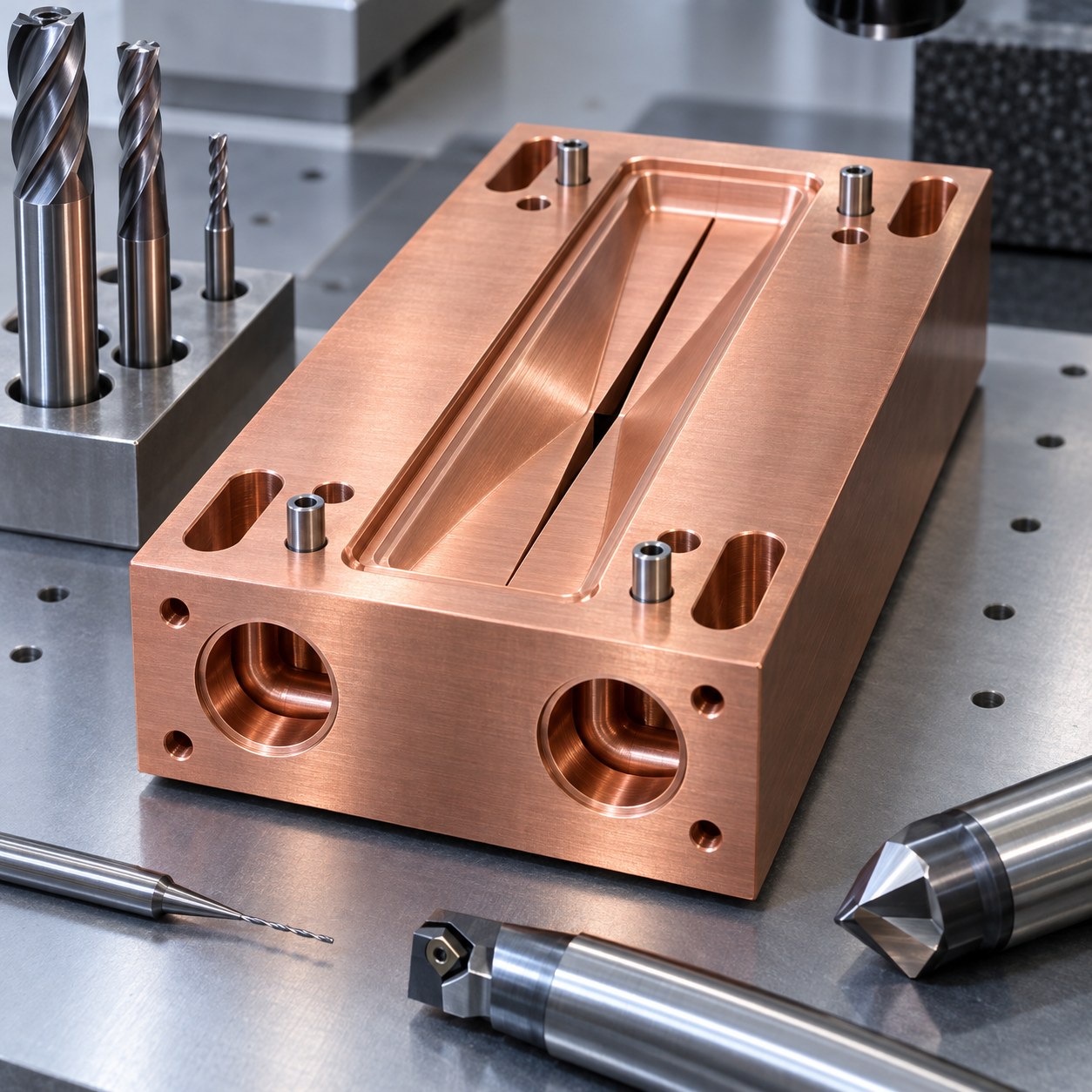
English: C11000 Beam Mask Tooling for Tapered Aperture and Cooling Ports
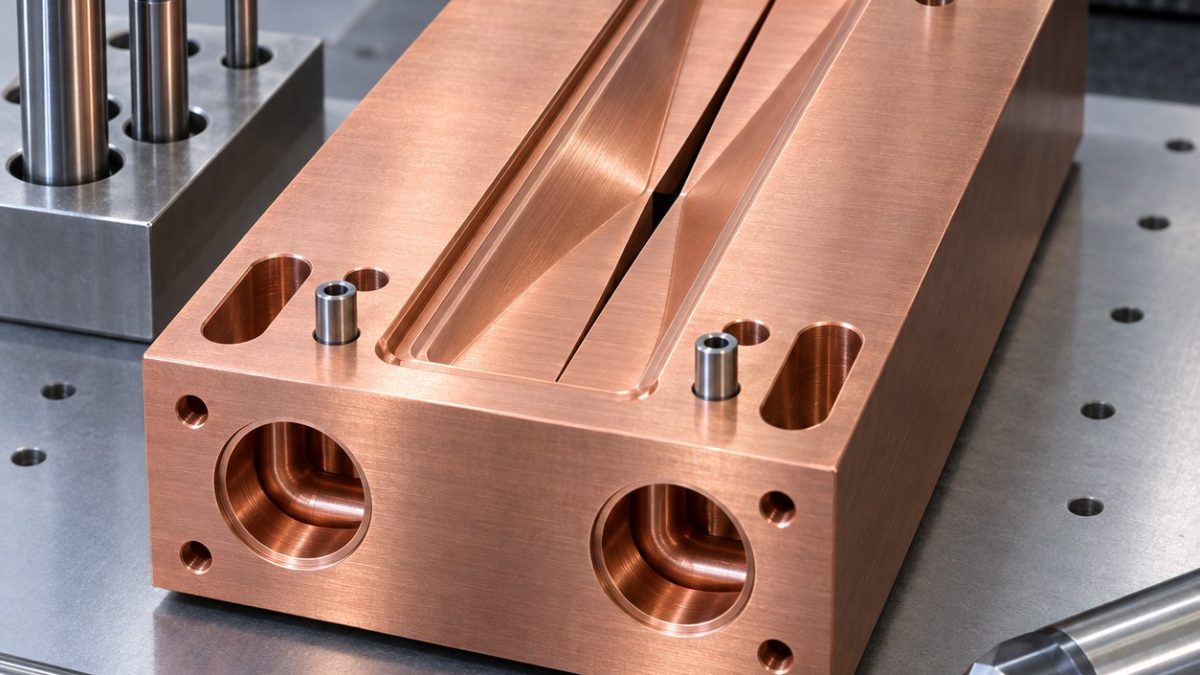
The long-tail question is how to machine a narrow tapered beam aperture without smearing its exit while two cooling ports must remain parallel to the vacuum seal land. The hypothetical drawing uses the seal face as A, two dowels as B-C and locates the aperture from that frame; exterior stock is not a datum.
Read functional datums before selecting tools
Face A and finish dowel bores while the blank is solid. Pilot and semifinish both cooling ports, rough the aperture from alternating sides with a sacrificial bridge at each end, then finish port bores. Use a vacuum-assisted nest for the taper finish and remove bridges last; mill mounting slots only after released flatness is known.
Match each drawing feature to a cutter
| Drawing feature | Carbide tool and holder | Why selected / alternative rejected |
|---|---|---|
| Vacuum seal face | 12 mm 3-flute polished uncoated carbide end mill, hydraulic holder | Sharp positive edge avoids copper smearing; a coated steel cutter builds an edge. |
| Tapered aperture roughing | 4 mm 2-flute polished carbide end mill, reduced neck, shrink holder | Alternating side ramps preserve the central web; full-width plunging bends it. |
| Aperture finish | 1 mm single-flute polished carbide taper mill, precision collet | One flute clears ductile chips; a four-flute micro tool recuts whiskers. |
| Cooling ports | Carbide pilot drill then short single-edge boring tool with through coolant | Boring controls parallelism; a long HSS drill wanders in soft copper. |
| Mounting slots and dowels | 3-flute polished carbide mill, carbide drill and PCD-tipped reamer | Reaming ties location to A-B-C; interpolation alone does not hold dowel finish. |
Control material-specific failure modes
OFE copper welds to a dull edge and produces long whiskers. Keep polished flutes clean, limit runout and evacuate chips without recutting. Replace the taper tool when the exit turns glossy or develops a folded lip. Do not hand-file the aperture because geometry and cleanliness are both functional.
Verify the released part
Measure seal-face flatness, dowel relation and cooling-port parallelism first. Inspect aperture width at inlet, throat and exit with noncontact optics, then borescope both port intersections. Vacuum, cooling and beam-performance qualification remain separate tests.
Practical tooling FAQ
Why leave bridges at the aperture ends?
They keep the narrow web supported until all high-force port work is complete.
Why use noncontact aperture inspection?
A contact stylus can mark soft copper and cannot reliably enter the narrow throat.
copper heat-spreader groove tooling · precision copper bore selection