English: Indexable T-Slot Cutter Selection for 5083 Aluminum Rails
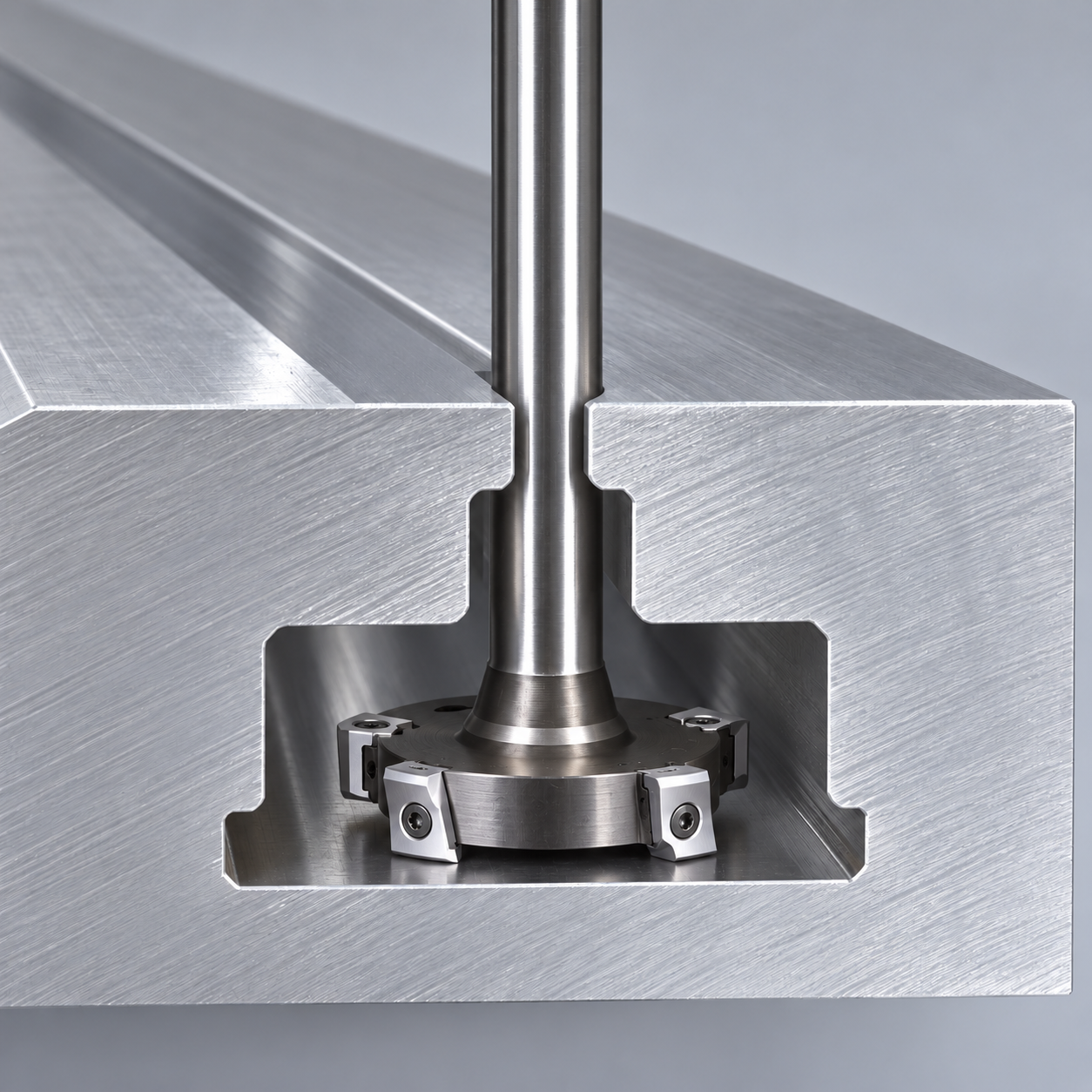
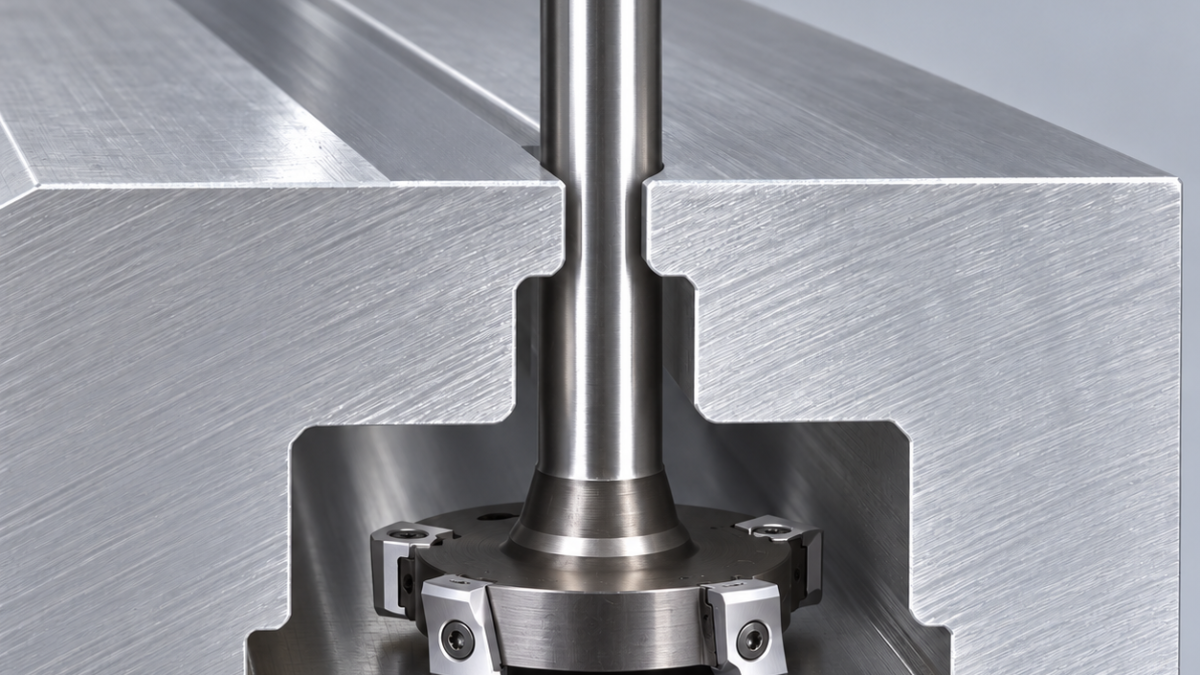
The neck clearance, not just the disc diameter, determines whether a T-slot cutter can finish an aluminum rail safely. This hypothetical 5083 rail has an open-ended 18.10–18.20 mm throat, a 32.00–32.08 mm undercut and a 14.00–14.06 mm undercut height. A candidate 31.75 mm square-insert head leaves room for controlled correction, but only after the actual neck, corner radii and top/bottom cutting envelopes are checked.
Four faces hide behind one slot width
The drawing must distinguish throat walls, lower side walls and the two horizontal bearing faces. The small radii left by the inserts must fit the specified corner relief, not be ignored because a T-nut slides through. Locate the rail on its base and side datum; distribute clamps over solid webs rather than pressing the lips inward. Both ends remain accessible for entry, exit and chip transport.
| Feature | Practical tool selection | Why this tool, not the tempting substitute |
|---|---|---|
| Open throat | 12 mm three-flute polished-carbide end mill; rough then finish the 18.10–18.20 mm opening | An end mill makes the access channel before any undercut tool enters |
| Lower T channel | Candidate M4575-032-class body: 31.75 mm head, 17 mm neck, 13.75 mm cutting width, two effective teeth; exact approved square carbide inserts | Check the complete assembly, not a similarly shaped square insert from another cutter |
| Bearing faces | Controlled small axial and lateral corrections with the qualified top/bottom cutting edges | A fixed-width head does not automatically produce the 14.00–14.06 mm band |
| Hidden and exposed burrs | Accessible carbide back-chamfer tool plus small top chamfer mill | Do not roll an unseen burr into the sliding surface |
Give aluminum chips an exit route
Specify sharp, positive geometry and a low-adhesion surface qualified for 5083. Prefer polished uncoated carbide when available in the exact approved system; otherwise trial the supplier’s aluminum-suitable coating and geometry. Do not substitute a heavily honed steel insert merely because its seat fits. The M4575 reference establishes a body concept and dimensions, not automatic approval of every grade for this rail.
Finish the throat and clear its chips before moving the disc in from an open end at the undercut level. This is a radial entry operation, not a plunge through the narrow throat. Verify the shaft and holder along the entire path. The 17 mm neck has only limited lateral room; a width correction must include neck displacement in the clearance check. Use the prescribed shank holder and gripping length, with restrained overhang. Compute feed using effective teeth, not the total number of visible inserts.
Finish the lips without using them as springs
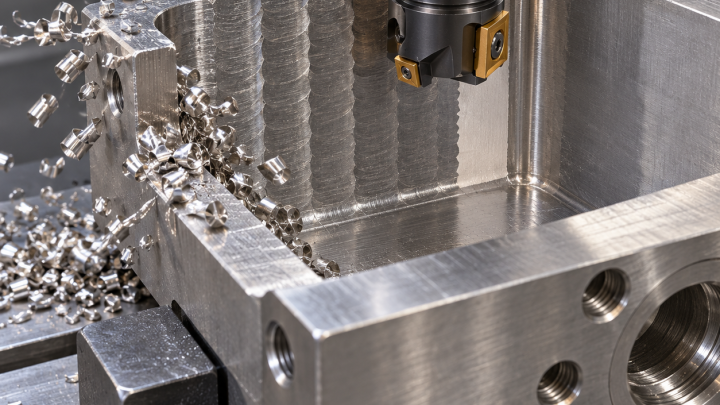
Rough the undercut with stable engagement and leave measured stock for each functional face. Avoid burying both sides in an unverified full-width heavy cut. Flush chips through the open end with a consistent coolant arrangement; sticky accumulation can weld to the edge, enlarge the apparent cutter envelope and scar a hidden face. No unattended recutting through packed chips is acceptable.
Use small documented correction passes for final width and height, after checking the top and bottom edge runout. Deburr while access is still available, clean, then release the clamps before final measurement. The hypothetical bearing-face requirement is Ra 1.6 µm; inspect those faces with suitable access, and measure undercut width and height near both ends and mid-length. A functional T-nut checks assembly but does not identify a tapered channel or bent lip.
Questions about the hidden channel
Can the disc enter through the throat from above? Not when its head is wider than the throat; use the open end. Why does the nut bind only after unclamping? Check lip movement and trapped burrs before adjusting the cutter diameter.
Compare the access and side-edge control in the open-slot disc-milling case. The UHMWPE guide-rail T-slot example illustrates a different material response; its plastic-cutting parameters must not be transferred to aluminum.
For the three-flute access-channel tool, the material, coating and engagement guide explains why an aluminum recipe cannot be selected by coating color alone.
Tool-system reference; the workpiece and inspection examples above are hypothetical.